Saturday, December 19, 2020

#620 A hydrogel is composed of crosslinked

A hydrogel is composed of crosslinked - Chemistry

ChemistryExplain daily providing Q&A content “#620 A hydrogel is composed of crosslinked" in Chemistry, Acs organic chemistry study guide, Adhesion chemistry, Aleks chemistry, Analytical chemistry jobs, Aromatic chemistry, Carbon chemistry

ChemistryExplain “#620 A hydrogel is composed of crosslinked in Chemistry, Acs organic chemistry study guide, Adhesion chemistry, Aleks chemistry

Get the Free Online Chemistry Q&A Questions And Answers with explain. To crack any examinations and Interview tests these Chemistry Questions And Answers are very useful. Here we have uploaded the Free Online Chemistry Questions. Here we are also given the all chemistry topic.

 ChemistryExplain team has covered all Topics related to inorganic, organic, physical chemistry, and others So, Prepare these Chemistry Questions and Answers with Explanation Pdf.

For More Chegg Questions

Join Our Telegram Channel for Covers All Update by ChemistryExplain:- Click Now

Free Chegg Question

A hydrogel is composed of crosslinked polymer chains, which are highly water absorbent. The gels are mostly (mostly>90%) water.
Liesegang linc patterns are precipitation patterns that appear in a gel when a chemical reaction takes place when a diffusing chemical (reactant A) in a gel reaches a concentration that is just enough to react with the reactant B (already present and homogeneously distributed in the gel) to form a precipitate. This precipitate appears as a colored line in the gel. Once the precipitate forms, reactant A is consumed all - howerver, diffusion of A does not stop. A ions propagate deeper into the gel and form another line of the precipitate when the A concentration again reaches the threshold concentration, just enough to react with the reactant B.

ChemistryExplain “#620 A hydrogel is composed of crosslinked in Chemistry, Acs organic chemistry study guide, Adhesion chemistry, Aleks chemistry

2) at which temperature the line would appear at the same distance from the start, cut in 75 min?

ChemistryExplain “#620 A hydrogel is composed of crosslinked in Chemistry, Acs organic chemistry study guide, Adhesion chemistry, Aleks chemistry

2) at which temperature the line would appear at the same distance from the start but in 75 min?

(Assume that the reaction only occurs when the Cu2+ concentration reaches the threshold concentration, and no reaction occurs before this time. In reality, the formation of patterns can only be explained/modeled by more complex reaction-diffusion equations.)

Free Chegg AnswerFor More Chemistry Notes and Helpful Content Subscribe Our YouTube Chanel - Chemistry Explain  

Free Chegg Answer 

Cu reaction with cro42- to form precipitate lines, which formed initially below the cu2+ sol as the limiting reagent is cu solution and the reaction progress the line shifts as the completion of Cu favors the formation of cucro4 ppt. And this reaction occurs at 25 degrees depth of the precipitation line formed is 3 meters.

As the line formed at 3 m depth and the reaction progress the line formation shifts.

The same precipitation line formed at 75 min time at 100-degree temp.

As the reaction occurs at 100-degree celsius at 0.05 M conc the reaction favors precipitation line forms at the same depth of initial formation at 3 m depth

Labels: , ,

Thursday, November 26, 2020

#535 What mass of Cu(IO3)2 can be formed

What mass of Cu(IO3)2 can be formed - Chemistry

ChemistryExplain daily providing Q&A content “#535 What mass of Cu(IO3)2 can be formed" in Chemistry, Acs organic chemistry study guide, Adhesion chemistry, Aleks chemistry, Analytical chemistry jobs, Aromatic Chemistry, Carbon chemistry

ChemistryExplain “#535 What mass of Cu(IO3)2 can be formed" in Chemistry, Acs organic chemistry study guide, Adhesion chemistry, Aleks chemistry

Get the Free Online Chemistry Q&A Questions And Answers with explain. To crack any examinations and Interview tests these Chemistry Questions And Answers are very useful. Here we have uploaded the Free Online Chemistry Questions. Here we are also given the all chemistry topic.

 ChemistryExplain team has covered all Topics related to inorganic, organic, physical chemistry, and others So, Prepare these Chemistry Questions and Answers with Explanation Pdf.

For More Chegg Questions

Join Our Telegram Channel for Covers All Update by ChemistryExplain:- Click Now

Free Chegg Question

What mass of Cu(IO3)2 can be formed from 0.500 g of CuSO4 · 5H2O?

Free Chegg AnswerFor More Chemistry Notes and Helpful Content Subscribe Our YouTube Chanel - Chemistry Explain  

Free Chegg Answer

  1. Step 1 of 2

    Equation balanced in terms of Cu could be written as

    Therefore, one mole of  gives one mole of 

    Calculate moles of 

    Given:

    mass 

    One mole of  is equivalent to one mole of 

  2. Step 2 of 2

    Convert moles to mass:

    We know the molar mass of 

    Thus, the mass of  formed is 

Labels: , ,

#534 What mass of KIO3 is needed to convert the copper

What mass of KIO3 is needed to convert the copper - Chemistry

ChemistryExplain daily providing Q&A content “#534 What mass of KIO3 is needed to convert the copper" in Chemistry, ACS organic chemistry study guide, Adhesion chemistry, Aleks chemistry, Analytical chemistry jobs, Aromatic Chemistry, Carbon chemistry

ChemistryExplain “#534 What mass of KIO3 is needed to convert the copper in Chemistry, ACS organic chemistry study guide, Adhesion chemistry
Get the Free Online Chemistry Q&A Questions And Answers with explain. To crack any examinations and Interview tests these Chemistry Questions And Answers are very useful. Here we have uploaded the Free Online Chemistry Questions. Here we are also given the all chemistry topic.

 ChemistryExplain team has covered all Topics related to inorganic, organic, physical chemistry, and others So, Prepare these Chemistry Questions and Answers with Explanation Pdf.

For More Chegg Questions

Join Our Telegram Channel for Covers All Update by ChemistryExplain:- Click Now

Free Chegg Question

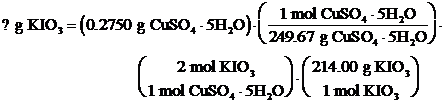
What mass of KIO3 is needed to convert the copper in 0.2750 g of CuSO4 • 5H2O to Cu(IO3)2?

Free Chegg AnswerFor More Chemistry Notes and Helpful Content Subscribe Our YouTube Chanel - Chemistry Explain  

Free Chegg Answer

  1. Step 1 of 2

    First, write out the chemical equation.

    ChemistryExplain “#534 What mass of KIO3 is needed to convert the copper in Chemistry, ACS organic chemistry study guide, Adhesion chemistry

  2. Step 2 of 2

    Use the stoichiometric coefficients and molar masses to perform unit analysis and determine the mass of KIO3 needed for the given amount of CuSO4 pentahydrate.

    ChemistryExplain “#534 What mass of KIO3 is needed to convert the copper in Chemistry, ACS organic chemistry study guide, Adhesion chemistry

    To convert CuSO4 pentahydrate to Cu(IO3)20.4714 g KIO3 is required.

Labels: , ,

Saturday, November 7, 2020

#464 What experimental design would you

What experimental design would you - Chemistry

ChemistryExplain daily providing Q&A content “#464 What experimental design would you" in Chemistry, Acs organic chemistry study guide, Adhesion chemistry, Aleks chemistry, Analytical chemistry jobs, Aromatic chemistry, Carbon chemistry

ChemistryExplain “#464 What experimental design would you in Chemistry, Acs organic chemistry study guide, Adhesion chemistry

Get the Free Online Chemistry Q&A Questions And Answers with explain. To crack any examinations and Interview tests these Chemistry Questions And Answers are very useful. Here we have uploaded the Free Online Chemistry Questions. Here we are also given the all chemistry topic.

 ChemistryExplain team has covered all Topics related to inorganic, organic, physical chemistry, and others So, Prepare these Chemistry Questions and Answers with Explanation Pdf.

For More Chegg Questions

Free Chegg Question

As a recent graduate of RMIT University you have just been employed (3-year contract) by a world-renowned infectious diseases institute located in Victoria, Australia. You are required to investigate the effects of the novel small molecule anti-viral (DAD030981) to determine the global metabolic changes which take place in the tissue of lungs of monkeys infected by SARS- CoV-2 (Infected Group) vs the tissue of lungs of healthy monkeys (Control Group). You have been asked by your laboratory head to design and carry out a “metabolomics experiment.”

Q1. What experimental design would you propose to your lab head? He will first need to approve this and then discuss with you how you are going to prepare samples and analyse them before you begin.

Q2. Congratulations! Your lab head has approved your project and has now asked you to provide details as to how you are going to prepare samples for your metabolomics experiment.

Briefly describe your proposed sample preparation workflow ONLY and provide a justification for each step.

What kind of internal standard do you propose to use and why?

Q3. Your lab head has now asked you to analyse the polar metabolite extract on the laboratory’s GC-MS.

Briefly describe how it may be possible to analyse polar metabolites on the GC-MS. What additional sample should you run with you experiment and why?

Q4. Your lab head is quite pleased that you have acquired all data in such a short amount of time and is now eager for you to analyse the data.

Briefly explain what and why deconvolution is important in appropriately identifying metabolites.

How can your lab head determine which metabolites are up and/or down regulated? How can your lab head determine which metabolites are statistically significant?

Free Chegg AnswerFor More Chemistry Notes and Helpful Content Subscribe Our YouTube Chanel - Chemistry Explain  

Free Chegg Answer

Part 1
Metabolomics is the large-scale study of small molecules, commonly known as metabolites, within cells, biofluids, tissues or organisms. Collectively, these small molecules and their interactions within a biological system are known as the metabolome. Metabolomics strives to obtain complete metabolic fingerprints, to detect differences between them and to provide hypotheses to explain those differences. This area of research is still rapidly developing into a powerful tool in the study of all types of organisms.

Design of experiment

1. Parallel samples should be six to eight. Those of model animal should be about 10. For clinical specimens, it requires 20 to 30.

2. Samples can not be pooling or repeated freezing and thawing, serum / plasma can not be hemolytic. In addition, if using plasma, researchers should use heparin sodium anticoagulation, for the effect of EDTA anticoagulant is not good enough.

3. For NMR, there should be no alcohol or anesthetic. As for urine, feces, intestinal contents samples, sodium azide is also needed.

The two basic experimental designs used in metabolomics are

(a) highly controlled laboratory studies in animal models or in vitro tissue culture and

(b) clinical epidemiological studies to investigate pathogenesis of diseases, biomarkers, drug efficacy, and toxicity.

The choice between univariate vs. multivariate methods is largely driven by the scientific question of interest. If the primary objective of the study is to identify all metabolites associated with a particular outcome, the univariate methods are preferable. If the primary objective instead is to utilize potentially multiple metabolites to predict the outcome of interest, then multivariate methods will be preferred.

Part 2

Sample preparation

Microbiological and cellular samples: rapid inactivation of metabolic activity (quenching), keeping cells undivided.

Animal body fluids: rapid pretreatment after sampling by adding anticoagulants, preservatives, and immediate freeze (-80 ° C).

Serum samples: 500ul / cases (not less than 200ul / cases), must avoid repeated freeze-thaw.

Urine sample: 1ml / example.

Metabolic flux can occur in seconds to minutes, unlike changes in levels of proteins and transcripts, which by and large turn out over minutes or hours. Therefore, sample collection and preparation are one of the most important steps in metabolomics experiments, as suboptimal handling can consequently reduce the accuracy and precision of the results.

Samples can be in the form of blood, serum, plasma, urine, cerebrospinal fluid (CSF), solid tissues, and cells. In the eye, commonly used tissues or fluids are cornea, lens, retina, vitreous, and aqueous. Typically, >30 mg wet tissue is mentioned for untargeted studies. Different sample types require different collection processes and preparation although the principles remain similar. The objective of this step is to quench metabolic activity in the samples and then to isolate or extract the metabolites in an appropriate solvent for the analytical instrument. Quenching is performed to stop or slow down the metabolic activities so that metabolic flux is minimised or eliminated from the sample as soon as possible after collection. It can be performed by reducing the temperature to sub-zero immediately after collection and storing it at −80 °C until the sample is ready for further processing.

The raw data received from analytical instruments is converted into computer-readable formats congruent with relevant software packages. During the analysis of MS data, it abides a pre-processing step to render order between samples and this usually converts continuous data to segmented data. In a chromatography–MS experiment, a 3D matrix of retention time vs mass vs intensity is converted to a 2D matrix of chromatographic peaks and peak areas or heights. This process is called ‘deconvolution’ and provides alignment of retention time and accurate mass.

If Principal Components Analysis (PCA) plot shows separation between the study group and the controls, and the quality control samples are firmly grouped in comparision to the other classes in the experiment, the biological difference between the classes is valid compared with differences due to technical bend during analysis.

Part 3

The last step is to select a metabolite status to the specific peaks induced from either MS or NMR. Data sets induced from metabolic profiling experiments can be very large and the classifying metabolites on a large scale remains an obstruction in metabolomics. Recent technologies have driven the development of comprehensive databases to solve this problem.

The GC works on the principle that a mixture will separate into individual substances when heated. The heated gases are carried through a column with an inert gas (such as helium). As the separated substances emerge from the column opening, they flow into the MS.

Two classifications of identification: (1) Putative identification, where one or two molecular assets are used for identification but an authentic chemical standard is not used; (2) Definitive identification, which is the more methodical form of identification, employs at least two properties (typically the retention time and accurate mass and/or fragmentation mass spectrum and/or NMR spectrum) and compares these properties with an authentic chemical standard analysed under identical analytical conditions. Typically following putative identification, definitive identification is performed on selected metabolites using the relevant authentic standards.

Part 4

The combination of two-dimensional (2D) GC × GC to a fast detector such as time-of-flight (TOF) working at acquisition rates up to 500 MHz and combined with a apt spectral deconvolution assists to fully design peak metabolites and prepares the detection of up to several thousand peaks in a single GC × GC run.

Up and down regulated metabolites

The lab head determined estimates based on two-dimensional gel electrophoresis of proteins, subtractive hybridization, and differential display of mRNA. It was found that ∼4% of the genes in flesh fly pupae are diapause upregulated. The execution patterns fall into diverse discrete categories: genes unaffected by diapause, genes downregulated throughout diapause, genes upregulated throughout diapause, early diapause genes, late diapause genes, and those expressed sometimes around diapause.
Among the most diapause-upregulated genes in the flesh fly are those that encode the 70 kDa heat shock protein (Hsp70) and Hsp23. Both of these genes are swiftly upregulated at the origin of diapause and hang out upregulated throughout diapause, even at cool out temperatures. When diapause is wrapped with hexane, both genes are downregulated within 6 h.

Determine which metabolites are statistically significant

The Lab head adopted multiple testing repairs, such as the Bonferroni correction for controlling the global type I error rate and the Benjamini–Hochberg correction for controlling the false discovery rate (FDR).
This approach involves M tests, where M is the total number of metabolite variables analyzed severally in relation to an end result. The P value for each separate metabolite test can be considered significant or non-significant based on a P value origin that is corrected to account for the fact that multiple hypotheses are being tested. The approach provided a measure of statistical significance for each covariate that is easy to decode.

Labels: , ,

Thursday, October 15, 2020

#376 Per prm the following conversions

Per prm the following conversions - Chemistry

ChemistryExplain daily providing Q&A content “#376 Per prm the following conversions" in Chemistry, Acs organic chemistry study guide, Adhesion chemistry, Aleks chemistry, Analytical chemistry jobs, Aromatic chemistry, Carbon chemistry

ChemistryExplain “#376 Per prm the following conversions in Chemistry, Acs organic chemistry study guide, Adhesion chemistry, Aleks chemistry
Get the Free Online Chemistry Q&A Questions And Answers with explain. To crack any examinations and Interview tests these Chemistry Questions And Answers are very useful. Here we have uploaded the Free Online Chemistry Questions. Here we are also given the all chemistry topic.

 ChemistryExplain team has covered all Topics related to inorganic, organic, physical chemistry, and others So, Prepare these Chemistry Questions and Answers with Explanation Pdf.

For More Chegg Questions

Free Chegg Question

Per prm the following conversions:

1..30 x 10- Mm to m

2. $609 us to s

3. Convert 0.000 000 040 KL to mL

4.45.0 cm to mL

5. 3300 mL to m

6. Convert 4.03 x 10 cm' to m

7. Convert 5.090 x 10 KL to m

8.607.0 in to m

9. 345.25 days to Gs

10. A cube 152.5 cm on each side to L

11.45.00 g to L if the density is 16.5 g/cm

12.40.0 Gg to ng

13. 532 nm to km

14. Convert 0.000 000 000 450 Mg to ug

15. 10.6 mL to mg if the density is 1.009 g/cm

16. Convert 2.09 x 10 g to KL if the density is 11.34 g 

ChemistryExplain “#376 Per prm the following conversions in Chemistry, Acs organic chemistry study guide, Adhesion chemistry, Aleks chemistry

Free Chegg AnswerFor More Chemistry Notes and Helpful Content Subscribe Our YouTube Chanel - Chemistry Explain  

Free Chegg Answer

ChemistryExplain “#376 Per prm the following conversions in Chemistry, Acs organic chemistry study guide, Adhesion chemistry, Aleks chemistry

 ChemistryExplain “#376 Per prm the following conversions in Chemistry, Acs organic chemistry study guide, Adhesion chemistry, Aleks chemistry
ChemistryExplain “#376 Per prm the following conversions in Chemistry, Acs organic chemistry study guide, Adhesion chemistry, Aleks chemistry

Labels: , ,

#375 Give products for reactions i-iv and briefly

Give products for reactions i-iv and briefly indicate your rationale - Chemistry

ChemistryExplain daily providing Q&A content “#375 Give products for reactions i-iv and briefly" in Chemistry, Acs organic chemistry study guide, Adhesion chemistry, Aleks chemistry, Analytical chemistry jobs, Aromatic chemistry, Carbon chemistry

ChemistryExplain “#375 Give products for reactions i-iv and briefly in Chemistry, Acs organic chemistry study guide, Adhesion chemistry
Get the Free Online Chemistry Q&A Questions And Answers with explain. To crack any examinations and Interview tests these Chemistry Questions And Answers are very useful. Here we have uploaded the Free Online Chemistry Questions. Here we are also given the all chemistry topic.

 ChemistryExplain team has covered all Topics related to inorganic, organic, physical chemistry, and others So, Prepare these Chemistry Questions and Answers with Explanation Pdf.

For More Chegg Questions

Free Chegg Question

Give products for reactions i-iv and briefly indicate your rationale.

ChemistryExplain “#375 Give products for reactions i-iv and briefly in Chemistry, Acs organic chemistry study guide, Adhesion chemistry

Free Chegg AnswerFor More Chemistry Notes and Helpful Content Subscribe Our YouTube Chanel - Chemistry Explain  

Free Chegg Answer

ChemistryExplain “#375 Give products for reactions i-iv and briefly in Chemistry, Acs organic chemistry study guide, Adhesion chemistry

ChemistryExplain “#375 Give products for reactions i-iv and briefly in Chemistry, Acs organic chemistry study guide, Adhesion chemistry


Labels: , ,

Wednesday, October 14, 2020

#374 Why doesn't polymerization take place

Why doesn't polymerization take place - Chemistry

ChemistryExplain daily providing Q&A content “#374 Why doesn't polymerization take place" in Chemistry, Acs organic chemistry study guide, Adhesion chemistry, Aleks chemistry, Analytical chemistry jobs, Aromatic chemistry, Carbon chemistry

ChemistryExplain “#374 Why doesn't polymerization take place in Chemistry, Acs organic chemistry study guide, Adhesion chemistry
Get the Free Online Chemistry Q&A Questions And Answers with explain. To crack any examinations and Interview tests these Chemistry Questions And Answers are very useful. Here we have uploaded the Free Online Chemistry Questions. Here we are also given the all chemistry topic.

 ChemistryExplain team has covered all Topics related to inorganic, organic, physical chemistry, and others So, Prepare these Chemistry Questions and Answers with Explanation Pdf.

For More Chegg Questions

Free Chegg Question

1. Why doesn't polymerization take place in the droplets instead of in the micelles in emulsion polymerization?

2. Why doesn't initiation occur in the micelles in emulsion polymerization?

3. Describe a gel for drug release.

4. Compare the properties of PMMA and glass.

5. Why is the Tg of PTFE higher than that of FEP?

Free Chegg AnswerFor More Chemistry Notes and Helpful Content Subscribe Our YouTube Chanel - Chemistry Explain  

Free Chegg Answer

It is mainly because the polymerization reaction will take place in the droplets instead of micelles in the case of emulsion polymerization are water soluble therefore they don't usually dissolve in monomer which is present outside the micelles & therefore it actually inhibits the polymerization in the form of big monomer droplets. Once the reaction of polymerization initiates, the micelle is then called as a particle

Labels: , ,

#373 What technique(s) would you use to determine

What technique(s) would you use to determine - Chemistry

ChemistryExplain daily providing Q&A content “#373 What technique(s) would you use to determine" in Chemistry, Acs organic chemistry study guide, Adhesion chemistry, Aleks chemistry, Analytical chemistry jobs, Aromatic chemistry, Carbon chemistry

ChemistryExplain “#373 What technique(s) would you use to determine in Chemistry, Acs organic chemistry study guide, Adhesion chemistry

Get the Free Online Chemistry Q&A Questions And Answers with explain. To crack any examinations and Interview tests these Chemistry Questions And Answers are very useful. Here we have uploaded the Free Online Chemistry Questions. Here we are also given the all chemistry topic.

 ChemistryExplain team has covered all Topics related to inorganic, organic, physical chemistry, and others So, Prepare these Chemistry Questions and Answers with Explanation Pdf.

For More Chegg Questions

Free Chegg Question

6. What technique(s) would you use to determine crystallinity in a polymer?

7. What thermal instrumental technique would you use to determine Tg?

8. What is the medium in which liposomes are built? What inter molecular forces drive this process?

9. What is hydroxyapatite (HA) and what is its role in the body?

10. Apply what you know about bone mineralization to tooth enamel. What are the intermolecular forces involved in the biomineralization of tooth enamel?

Free Chegg AnswerFor More Chemistry Notes and Helpful Content Subscribe Our YouTube Chanel - Chemistry Explain  

Free Chegg Answer

Ans 6.The crystallinity of a polymer refers to the degree as to which there are regions where the polymer chains are aligned with one another.

Differential scanning calorimetry (DSC) provides a rapid method for determining polymer crystallinity based on the heat required to melt the polymer.

Ans 7. Differential scanning calorimetry technique is use to determine glass transition temperature(Tg)

Ans 9. Hydroxyapatite is a naturally occurring form of the mineral calcium apatite-calcium,phosphate and oxygen that grows in hexagonal crystals.

Role of HA in the body

1.It makes most of the human bone structure.

2.It builds tooth enamel.

3.It collects in tiny amounts in parts of the brain.

Labels: , ,

#372 What is the structure of the cell membrane

What is the structure of the cell membrane - Chemistry

ChemistryExplain daily providing Q&A content “#372 What is the structure of the cell membrane" in Chemistry, Acs organic chemistry study guide, Adhesion chemistry, Aleks chemistry, Analytical chemistry jobs, Aromatic chemistry, Carbon chemistry

ChemistryExplain “#372 What is the structure of the cell membrane in Chemistry, Acs organic chemistry study guide, Adhesion chemistry

Get the Free Online Chemistry Q&A Questions And Answers with explain. To crack any examinations and Interview tests these Chemistry Questions And Answers are very useful. Here we have uploaded the Free Online Chemistry Questions. Here we are also given the all chemistry topic.

 ChemistryExplain team has covered all Topics related to inorganic, organic, physical chemistry, and others So, Prepare these Chemistry Questions and Answers with Explanation Pdf.

For More Chegg Questions

Free Chegg Question

11. What is the structure of the cell membrane?

12. Why is the Tg of PTFE higher than that of FEP?

13. Compare and contrast dendrimers with block copolymer micelles, globular proteins, inorganic nanoparticles in terms of attributes and likely utility in the following applications: (a) drug delivery; (b) homogenous catalysis; and (c) solubilization. 14. Name three important synthetic fibers.

15. Which of the following might you expect would increase their conductivity when doped: (a) PS, (b) PPO, (c) nylon 66, or (d) aramids?

16. When a dilute solution of block copolymers undergoes micellization, i.e., some numbers of chains aggregate into a (usually spherical) assembly to shield one block from the solvent it does not like, the light scattering intensity increases. In fact, if micellization is induced by changing temperature at a fixed concentration, the ratio of the intensity after micellization to that before micellization is a good estimate of the average aggregation number of the micelles. Explain this observation.

Free Chegg AnswerFor More Chemistry Notes and Helpful Content Subscribe Our YouTube Chanel - Chemistry Explain  

Free Chegg Answer

11) Structure of cell membrane:

Cell membrane contains phospholipids which are main components. These phospholilids made up of a phosphate group and two fatty acid. The phosphate group is head while fatty acids are working as tails.

These properties of phospholipids allow them to spontaneously form a double-layered membrane. In an aqueous solution, the hydrophilic heads of phospholipids will orient themselves to be on the outside, while the hydrophobic tails will be on the inside. In addition to phospholipids, the cell membrane also contains glycolipids and sterols.

12) Higher Tg of PTFE than FEP:

FEP (fluorinated ethylene propylene) contains some of the same non-stick qualities of PTFE (polytetrafluoroethylene) but has different structure. FEP is softer than PTFE, hence  melts at a lower temperature than PTFE. Therefore, PTFE has higher Tg (glass temperature) than FEP.

Labels: , ,

#371 Numerical problems 1. At 721C, pº, after a pure Ha gas

Numerical problems 1. At 721C, pº, after a pure Ha gas - Chemistry

ChemistryExplain daily providing Q&A content “#371 Numerical problems 1. At 721C, pº, after a pure Ha gas" in Chemistry, Acs organic chemistry study guide, Adhesion chemistry, Aleks chemistry, Analytical chemistry jobs, Aromatic chemistry, Carbon chemistry

ChemistryExplain “#371 Numerical problems 1. At 721C, pº, after a pure Ha gas in Chemistry, Acs organic chemistry study guide, Adhesion chemistry

Get the Free Online Chemistry Q&A Questions And Answers with explain. To crack any examinations and Interview tests these Chemistry Questions And Answers are very useful. Here we have uploaded the Free Online Chemistry Questions. Here we are also given the all chemistry topic.

 ChemistryExplain team has covered all Topics related to inorganic, organic, physical chemistry, and others So, Prepare these Chemistry Questions and Answers with Explanation Pdf.

For More Chegg Questions

Free Chegg Question

II. Numerical problems 1. At 721C, pº, after a pure Ha gas slowly passes through excessive CoO(s), part of the oxide is reduced into Co(s). The flowing-out equilibrium gas contains 2.5% (volume fraction) Hz. At the same temperature, if we use CO gas to reduce Coo(s), the flowing-out equilibrium gas contains 1.92% (volume fraction ) CO. Then, if the same mole number of CO and water vapor are mixed up at 7210, and they undergo chemical reaction after an appropriate catalyst is added, how much is the equilibrium conversion percentage?

2. In the gas phase reaction 2A + B = 3C + 2D, it was found that, when 1.00 mol A, 2.00 mol B, and 1.00 mol D were mixed and allowed to come to equilibrium at 25 C, the resulting mixture contained 0.90 mol C at a total pressure of 1.00 bar. Calculate (a) the mole fractions of each species at equilibrium, (b) K., (c) K, and {d} 4,GⓇ.

3. The dissociation vapour pressure of NH4Cl at 427°C is 608 kPa but at 459°C it has risen to 1115 kPa. Calculate (a) the equilibrium constant, (b) the standard reaction Gibbs energy, (e) the standard enthalpy, and (d) the standard entropy of dissociation, all at 427°C. Assume that the vapour behaves as a perfect gas and that AHⓇ and AS® are independent of temperature in the range given.
2. In the gas phase reaction 2A + B = 3C + 2D, it was found that, when 1.00 mol A, 2.00 mol B, and 1.00 mol D were mixed and allowed to come to equilibrium at 25°C, the resulting mixture contained 0.90 mol C at a total pressure of 1.00 bar. Calculate (a) the mole fractions of each species at equilibrium, (b) Kx, (e) K, and {d} 4,6°.

ChemistryExplain “#371 Numerical problems 1. At 721C, pº, after a pure Ha gas in Chemistry, Acs organic chemistry study guide, Adhesion chemistry

Free Chegg AnswerFor More Chemistry Notes and Helpful Content Subscribe Our YouTube Chanel - Chemistry Explain  

Free Chegg Answer

SOLN 1

The complete Balanced reaction is written as

CoO(s) + H2(g) = Co(s) + H2O(g)

Given: 1 mole of H2.

Since at equilibrium, the Volume fraction which is also called as mole fraction of H2 is 2.5%. therefore rest will be H2O which has mole fraction equal to 97.5%.

Equilibrium constant K1= [H2O] /[H2] = 0.975/0.025 = 38.88

From the above reaction, Co(s)+ H2O---àCoO+H2(g) (1), K1’ = 1/38.88= 0.026

CoO+CO(g) ---àCO2(g)+ Co (2)

Given: 1 mole of CO

Since volume fraction of CO is 1.92%. hence remaining will be CO2 which has mole fraction is =100-1.92= 98.08%

Equilibrium constant, K2= 0.9808/0.0192 = 51.08

combining reaction 1 and 2

H2O+CO----àCO2+H2, K = K1’*K2= 51.08/0.026 = 1.33

assuming 1 mole of H2O which has to be mixed with 1 mole of CO

Let assume that x= percentage decomposition of H2O

Therefore at equilibrium, [CO] = [H2O] =1-x and [CO2] =[H2] =x

Therefore x2/(1-x)2= 1.33 or x/(1-x)= 1.33 or x= 1.33-1.33x

2.33x= 1.33 or x= 1.33/2.33 =.578

Labels: , ,

Monday, October 12, 2020

#366 oh PPhz + CHO CHO H - (CH3)₂ - s- c - CN ph

oh PPhz + CHO CHO H - (CH3)₂ - s- c - CN ph - Chemistry

ChemistryExplain daily providing Q&A content “#366 oh PPhz + CHO CHO H - (CH3)₂ - s- c - CN ph" in Chemistry, Acs organic chemistry study guide, Adhesion chemistry, Aleks chemistry, Analytical chemistry jobs, Aromatic chemistry, Carbon chemistry

ChemistryExplain “#366 oh PPhz + CHO CHO H - (CH3)₂ - s- c - CN ph" in Chemistry, Acs organic chemistry study guide, Adhesion chemistry, Aleks chemistry
Get the Free Online Chemistry Q&A Questions And Answers with explain. To crack any examinations and Interview tests these Chemistry Questions And Answers are very useful. Here we have uploaded the Free Online Chemistry Questions. Here we are also given the all chemistry topic.

 ChemistryExplain team has covered all Topics related to inorganic, organic, physical chemistry, and others So, Prepare these Chemistry Questions and Answers with Explanation Pdf.

For More Chegg Questions

Free Chegg Question

oh PPhz + CHO CHO H - (CH3)₂ - s- c - CN ph

ChemistryExplain “#366 oh PPhz + CHO CHO H - (CH3)₂ - s- c - CN ph" in Chemistry, Acs organic chemistry study guide, Adhesion chemistry, Aleks chemistry

Free Chegg AnswerFor More Chemistry Notes and Helpful Content Subscribe Our YouTube Chanel - Chemistry Explain  

Free Chegg Answer

ChemistryExplain “#366 oh PPhz + CHO CHO H - (CH3)₂ - s- c - CN ph" in Chemistry, Acs organic chemistry study guide, Adhesion chemistry, Aleks chemistry

Labels: , ,

#365 The dissociation vapour pressure of NH4Cl

The dissociation vapour pressure of NH4Cl - Chemistry

ChemistryExplain daily providing Q&A content “#365 The dissociation vapour pressure of NH4Cl" in Chemistry, Acs organic chemistry study guide, Adhesion chemistry, Aleks chemistry, Analytical chemistry jobs, Aromatic chemistry, Carbon chemistry

ChemistryExplain “#365 The dissociation vapour pressure of NH4Cl in Chemistry, Acs organic chemistry study guide, Adhesion chemistry, Aleks chemistry

Get the Free Online Chemistry Q&A Questions And Answers with explain. To crack any examinations and Interview tests these Chemistry Questions And Answers are very useful. Here we have uploaded the Free Online Chemistry Questions. Here we are also given the all chemistry topic.

 ChemistryExplain team has covered all Topics related to inorganic, organic, physical chemistry, and others So, Prepare these Chemistry Questions and Answers with Explanation Pdf.

For More Chegg Questions

Free Chegg Question

The dissociation vapour pressure of NH4Cl at 427°C is 608 kPa but at 459°C it has risen to 1115 kPa. Calculate (a) the equilibrium constant, (b) the standard reaction Gibbs energy, (e) the standard enthalpy, and (d) the standard entropy of dissociation, all at 427°C. Assume that the vapour behaves as a perfect gas and that AHⓇ and AS are independent of temperature in the range given.

II. Problems 1. At 298.15 K, Br2 is dissolved into ccls, and the mole fraction of Bra x(Bra)=0.0130. The partial pressure of Bra(g) in gas that is in equilibrium with the solution is 723.94Pa. Calculate the activity of Bra and the activity coefficient Yx under the following conditions: (1) The standard state is pure liquid Bra(l); (2) The activity coefficient of infinitely dilute Bra in Ccle solution is 1, if we have known that the vapor pressure of pure Brz(liquid) is 28397.7 Pa at 298.15 K, and the Henry constant k =54662 Pa. 2. If T = 25°C, P =100 kPa, ne mol of NaCl (B) mix with 55,5 mol of H20 (c) to form a solution, and the relationship between the V (cm') and ns can be described as follow:

ChemistryExplain “#365 The dissociation vapour pressure of NH4Cl in Chemistry, Acs organic chemistry study guide, Adhesion chemistry, Aleks chemistry

3. The liquid B and liquid C can form ideal liquid mixture. At 25°C, the addition of 14 mol of pure liquid C in to the 10 mol of mixture (B+C) with X = 0.4 can form a new mixture, calculate the AG of this mixing procedure.

Free Chegg AnswerFor More Chemistry Notes and Helpful Content Subscribe Our YouTube Chanel - Chemistry Explain  

Free Chegg Answer

SOLN 3

The balanced reaction is written as follows

NHACI(S) = NH3(g) + HCl(9)

Equilliribrium constant is written as

K, =pNH3(g) x pHCI9)

writing equillibrium pressure in terms of activity

K= aNH3(g) x aHCl(9) LaNH4Cl

For reference activity of pure solid is always assumed to be 1hence K reduces to:

K = aN H3(g) x aHCl g)

Activity of any gas is given by

po is the standard partial pressure

K = P;P

K - PNH3(g) pHCU9) K= po po

Hence Total pressure will be written as :

P = PNH, + PHCI

From the balances equation we see that

PNH - PHCl

P = PNH +PHCl = 2PNH-

pNH3(g) pHCI) pNH3(g) 1x P.12 X Do Po Ро po =Āxlpol

Hence at 427 °C:

K = = \frac {1}{4} \times [\frac{608}{100}]^2 = 9.24160

Hence at 459 °C:

K = \frac {1}{4} \times [\frac{1115}{100}]^2 = 31.08063

Calculating ΔG (at 427 °C) by using the expression:

AG = -RTINK= -12.945K Jmol-1

Calculating ΔH which doesn’t vary much with temperature

ln \frac{K_2}{K_1} = \frac {- \Delta H}{R} (\frac{T_2 - T_1}{T_1 \times T_2})

On Solving,

ΔH = + 161.5436788 KJ mol‐1

Now entropy can be calculated by rearranging the equation

\Delta G = \Delta H - T \Delta S

Thus ΔS = 249.2162589 J K‐1 mol‐1

According to Chegg Policy only 1 question per post is allowed. please post the rest question seperately.

Labels: , ,