Monday, December 7, 2020

#584 Hydrostatic Force on a Beach Dam

Hydrostatic Force on a Beach Dam - Mechanical Engineering

ChemistryExplain daily providing Q&A content “#584 Hydrostatic Force on a Beach Dam" in Mechanical Engineering, Best colleges for mechanical engineering, Entry level mechanical engineer, Mechanical engineering companies

ChemistryExplain “#584 Hydrostatic Force on a Beach Dam in Mechanical Engineering, Best colleges for mechanical engineering, Entry level mechanical engineer
Get the Free Online Chemistry Q&A Questions And Answers with explain. To crack any examinations and Interview tests these Chemistry Questions And Answers are very useful. Here we have uploaded the Free Online Chemistry Questions. Here we are also given the all chemistry topic.

 ChemistryExplain team has covered all Topics related to inorganic, organic, physical chemistry, and others So, Prepare these Chemistry Questions and Answers with Explanation Pdf.

For More Chegg Questions

Join Our Telegram Channel for Covers All Update by ChemistryExplain:- Click Now

Free Chegg Question

Hydrostatic Force on a Beach Dam

The concrete seawall has a curved surface and restrains seawater at a depth of 24 ft. The trace of the surface is a parabola as illustrated. Determine the moment of the fluid force (per unit length) with respect to an axis through the toe (point A).

ChemistryExplain “#584 Hydrostatic Force on a Beach Dam in Mechanical Engineering, Best colleges for mechanical engineering, Entry level mechanical engineer

Free Chegg AnswerFor More Chemistry Notes and Helpful Content Subscribe Our YouTube Chanel - Chemistry Explain  

Free Chegg Answer

ChemistryExplain “#584 Hydrostatic Force on a Beach Dam in Mechanical Engineering, Best colleges for mechanical engineering, Entry level mechanical engineer

ChemistryExplain “#584 Hydrostatic Force on a Beach Dam in Mechanical Engineering, Best colleges for mechanical engineering, Entry level mechanical engineer

ChemistryExplain “#584 Hydrostatic Force on a Beach Dam in Mechanical Engineering, Best colleges for mechanical engineering, Entry level mechanical engineer

Labels: , ,

Wednesday, September 30, 2020

#310 The hoist shown is used in a machine

The hoist shown is used in a machine - Mechanical Engineering

ChemistryExplain daily providing Q&A content “#310 The hoist shown is used in a machine" in Mechanical Engineering, Best colleges for mechanical engineering, Entry level mechanical engineer, Mechanical engineering companies

ChemistryExplain “#310 The hoist shown is used in a machine in Mechanical Engineering, Best colleges for mechanical engineering, Entry level mechanic

Read more »

Labels: , ,

Tuesday, September 29, 2020

#301 The shafts is hollow from A to B and

The shafts is hollow from A to B and - Mechanical Engineering

ChemistryExplain daily providing Q&A content “#301 The shafts is hollow from A to B and" in Mechanical Engineering, Best colleges for mechanical engineering, Entry level mechanical engineer, Mechanical engineering companies.

ChemistryExplain “#301 The shafts is hollow from A to B and in Mechanical Engineering, Best colleges for mechanical engineering, Entry level mechanical
Get the Free Online Chemistry Q&A Questions And Answers with explain. To crack any examinations and Interview tests these Chemistry Questions And Answers are very useful. Here we have uploaded the Free Online Chemistry Questions. Here we are also given the all chemistry topic.

 ChemistryExplain team has covered all Topics related to inorganic, organic, physical chemistry, and others So, Prepare these Chemistry Questions and Answers with Explanation Pdf.

For More Chegg Questions

Free Chegg Question

The shafts is hollow from A to B and solid from B to C. The shaft has an outer diameter of 80 mm, and the thickness of the wall of the hollow segment is 10 mm. Determine the maximum shear stress developed in the shaft. Also, compute the angle of rotation at the end A. Assume Shear Modulus = 12 x 10 Psi.

ChemistryExplain “#301 The shafts is hollow from A to B and in Mechanical Engineering, Best colleges for mechanical engineering, Entry level mechanical

For More Chemistry Notes and Helpful Content Subscribe Our YouTube Chanel - Chemistry Explain  

Free Chegg Answer

In given question, first of all we have to determine twisting moment acting on each shaft. The cross section have maximum twisting moment will have maximum shear stress at the surface of the shaft. I have directly used expression for maximum shear stress for hollow and solid shaft. Similarly for determining angle of rotation, i have used direct expression for hollow and solid shaft. Please refer below screenshot for more detailed solution.

ChemistryExplain “#301 The shafts is hollow from A to B and in Mechanical Engineering, Best colleges for mechanical engineering, Entry level mechanical

Labels: , ,

Thursday, September 17, 2020

#227 What are some of the principal irreversibilities present

What are some of the principal irreversibilities present - Mechanical Engineering

ChemistryExplain daily providing Q&A content “#227 What are some of the principal irreversibilities present" in Mechanical Engineering, Best colleges for mechanical engineering, Entry level mechanical engineer, Mechanical engineering companies

ChemistryExplain “#227 What are some of the principal irreversibilities present in Mechanical Engineering, Best colleges for mechanical engineering

Get the Free Online Chemistry Q&A Questions And Answers with explain. To crack any examinations and Interview tests these Chemistry Questions And Answers are very useful. Here we have uploaded the Free Online Chemistry Questions. Here we are also given the all chemistry topic.

 ChemistryExplain team has covered all Topics related to inorganic, organic, physical chemistry, and others So, Prepare these Chemistry Questions and Answers with Explanation Pdf.

For More Chegg Questions

Free Chegg Question

What are some of the principal irreversibilities present during the ation of

(a) an automobile engine,

(b) a household refrigerator,

(c) a gas-fired water heater,

(d) an electric water heater?

For More Chemistry Notes and Helpful Content Subscribe Our YouTube Chanel - Chemistry Explain  

Free Chegg Answer

Principal irreversibilities-

(a) Automobile Engine-

1.mechanical friction between moving parts

2.wear and corrosion

3.heat transfer across finite temperature differences

4.chemical reactions

(b) Household Refrigerator

1.isenthalpic throttling

2.Fluid friction

3.heat transfer to and from the surroundings.

(c) Gas fired water heater

1.heat interaction with surroundings

2.combustion

(d) Electric water heater

1.electrical resistance

2.copper losses

Labels: , ,

Tuesday, August 18, 2020

#127 For the one-dimensional fluid-flow problem with velocity known

For the one-dimensional fluid-flow problem with velocity known - Mechanical Engineering

ChemistryExplain daily providing Q&A content “#127 For the one-dimensional fluid-flow problem with velocity known" in Mechanical Engineering, Best colleges for mechanical engineering, Entry level mechanical engineer, Mechanical engineering companies
Chemistryexplain “#127 For the one-dimensional fluid-flow problem with velocity known in Mechanical Engineering, Best colleges for mechanical engineering,
Get the Free Online Chemistry Q&A Questions And Answers with explain. To crack any examinations and Interview tests these Chemistry Questions And Answers are very useful. Here we have uploaded the Free Online Chemistry Questions. Here we are also given the all chemistry topic.
 ChemistryExplain team has covered all Topics related to inorganic, organic, physical chemistry, and others So, Prepare these Chemistry Questions and Answers with Explanation Pdf.
For More Chegg Questions

Free Chegg Question

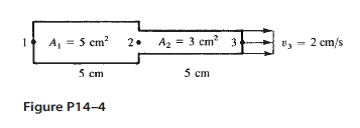
For the one-dimensional fluid-flow problem (Figure P14–4) with velocity known at the right end, determine the velocities and the volumetric flow rates at nodes 1 and 2. Let Kxx = 2 cm/s.


For More Chemistry Notes and Helpful Content Subscribe Our YouTube Chanel - Chemistry Explain  

Free Chegg Answer


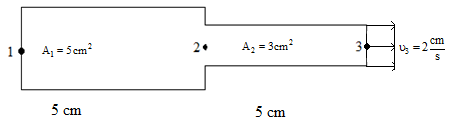
The following figure represents one-dimensional flow through the porous media:
Picture 5

From the preceding figure the following is the element stiffness matrix for the element-1:
 â€¦â€¦ (1)
Here is the permeability of the porous medium of element 1,is length of the element andis area of the element.
Substitute for,forandforin the equation (1):

From the preceding figure the following is the element stiffness matrix for the element-2:
 â€¦â€¦ (2)
Here is the permeability of the porous medium of element 2,is length of the element andis area of the element.
Substitute for,forandforin the equation (2):

Calculate the global Stiffness matrix by using the following formula:
 â€¦â€¦ (3)

The following matrix is the global nodal potential:
 â€¦â€¦ (4)

The following matrix is the force matrix:
 â€¦â€¦ (5)

Calculate the elemental force of the element-1 by using the following formula:
 â€¦â€¦ (6)
Here is velocity flow rate andis area of the element.
Substituteforandfor equation (6):

The elemental velocity at the remaining elements 1 and 2 is equal to zero.

The following are the potential boundary conditions:
The potential of element 1 is of the following: 


On applying the boundary conditions, the assembly of the element stiffness matrices produces the following system of equations:

In order find the potentials of elements 2 and 3 the preceding matrix form is reduced to the following form:

The preceding matrix form can be written in the equation form is of the following:
 â€¦â€¦ (7)
By solving the preceding equations, the following the potential at element 2 and 3 values were obtained:
 And.

Calculate the velocity of element 1 by using the following formula:
 â€¦â€¦ (8)
Substitute for,for,forand forin the equation (8):

Thus, the velocity of fluid at the element-1 is

Calculate the velocity of element 2 by using the following formula:
 â€¦â€¦ (9)
Substitute for,for,forand forin the equation (9):

Thus, the velocity of fluid at the element-2 is

Calculate the volumetric flow rate by using the following formula:
 â€¦â€¦ (10)
Substituteforandforin the equation (10):

Thus, the volume flow rate of fluid at element-1 is.

Calculate the volumetric flow rate by using the following formula:
 â€¦â€¦ (11)
Substituteforandforin the equation (11):

Thus, the volume flow rate of fluid at element-2 is.

Labels: , , ,