Sunday, December 20, 2020

#623 Water flows in a rectangular flume 1.5 m

Water flows in a rectangular flume 1.5 m - Mechanical Engineering

ChemistryExplain daily providing Q&A content “#623 Water flows in a rectangular flume 1.5 m" in Mechanical Engineering, Best colleges for mechanical engineering, Entry level mechanical engineer, Mechanical engineering companies

ChemistryExplain “#623 Water flows in a rectangular flume 1.5 m in Mechanical Engineering, Best colleges for mechanical engineering, Entry level mechanical engineer
Get the Free Online Chemistry Q&A Questions And Answers with explain. To crack any examinations and Interview tests these Chemistry Questions And Answers are very useful. Here we have uploaded the Free Online Chemistry Questions. Here we are also given the all chemistry topic.

 ChemistryExplain team has covered all Topics related to inorganic, organic, physical chemistry, and others So, Prepare these Chemistry Questions and Answers with Explanation Pdf.

For More Chegg Questions

Join Our Telegram Channel for Covers All Update by ChemistryExplain:- Click Now

Free Chegg Question

Water flows in a rectangular flume 1.5 m wide made of unplaned timber (n = 0.013). Find the necessary channel slope if the water flows uniformly at a depth of 0.6 m and at 4.5 m/s.

Free Chegg AnswerFor More Chemistry Notes and Helpful Content Subscribe Our YouTube Chanel - Chemistry Explain  

Free Chegg Answer

  1. Step 1 of 5

    Given data:

    Width of the rectangular flume 

    Manning’s coefficient 

    Velocity in the rectangular flume 

    Depth of flow in the rectangular flume 

  2. Step 2 of 5

    Channel cross section

    ChemistryExplain “#623 Water flows in a rectangular flume 1.5 m" in Mechanical Engineering, Best colleges for mechanical engineering, Entry level mechanical engineer

  3. Step 3 of 5

    Manning’s equation for velocity in SI units

    Where

    Hydraulic radius

    Area of the channel cross section

    Wetted perimeter

  4. Step 4 of 5

    Area of the channel cross section

    Wetted perimeter for the channel

  5. Step 5 of 5

    Hydraulic radius

    Thus, velocity in the channel

    Therefore the bed slope of the rectangular flume is 

Labels: , ,

Saturday, December 19, 2020

#621 Water flows uniformly in a 14-ft-diameter

Water flows uniformly in a 14-ft-diameter - Mechanical Engineering

ChemistryExplain daily providing Q&A content “#621 Water flows uniformly in a 14-ft-diameter" in Mechanical Engineering, Best colleges for mechanical engineering, Entry level mechanical engineer, Mechanical engineering companies

ChemistryExplain “#621 Water flows uniformly in a 14-ft-diameter in Mechanical Engineering, Best colleges for mechanical engineering, Entry level mec

Get the Free Online Chemistry Q&A Questions And Answers with explain. To crack any examinations and Interview tests these Chemistry Questions And Answers are very useful. Here we have uploaded the Free Online Chemistry Questions. Here we are also given the all chemistry topic.

 ChemistryExplain team has covered all Topics related to inorganic, organic, physical chemistry, and others So, Prepare these Chemistry Questions and Answers with Explanation Pdf.

For More Chegg Questions

Join Our Telegram Channel for Covers All Update by ChemistryExplain:- Click Now

Free Chegg Question

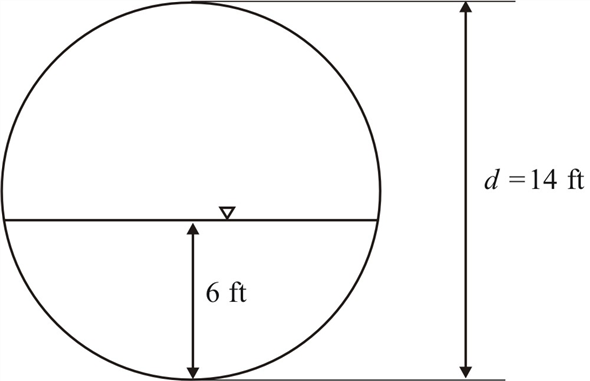
Water flows uniformly in a 14-ft-diameter concrete pipe (n = 0.014, S0 = 0.0004) at a depth of 6 ft. Using Fig. 10.10, determine the flow rate and the average flow velocity.

Free Chegg AnswerFor More Chemistry Notes and Helpful Content Subscribe Our YouTube Chanel - Chemistry Explain  

Free Chegg Answer 

  1. Step 1 of 7

    Given data:

    Manning’s coefficient 

    Bed slope of the concrete pipe 

    Depth of water 

    Diameter of the concrete pipe 

  2. Step 2 of 7

    Channel cross section

    ChemistryExplain “#621 Water flows uniformly in a 14-ft-diameter in Mechanical Engineering, Best colleges for mechanical engineering, Entry level mec

  3. Step 3 of 7

    Manning’s equation for flow rate in BG units

    Where

    Area of the channel cross section

    Hydraulic radius

    Wetted perimeter

  4. Step 4 of 7

    For full flow in the pipe

    Area of the channel cross section

    Wetted perimeter for the channel

  5. Step 5 of 7

    Hydraulic radius

    Thus, flow rate in the channel

  6. Step 6 of 7

    Velocity of flow when pipe is full

  7. Step 7 of 7

    Calculate the flow rate and average velocity for 6 ft depth of flow by using the diagram

    Hydraulic characteristics of circular pipe

    For 

     and 

    Therefore

    Flow rate

    Average velocity

    Hence the flow rate and average velocity for 6 ft depth of flow is and 

Labels: , ,

Thursday, December 17, 2020

#610 A Carnot heat engine receives heat from

A Carnot heat engine receives heat from - Mechanical Engineering

ChemistryExplain daily providing Q&A content “#610 A Carnot heat engine receives heat from" in Mechanical Engineering, Best colleges for mechanical engineering, Entry level mechanical engineer, Mechanical engineering companies

ChemistryExplain “#610 A Carnot heat engine receives heat from" in Mechanical Engineering, Best colleges for mechanical engineering, Entry level mecha
Get the Free Online Chemistry Q&A Questions And Answers with explain. To crack any examinations and Interview tests these Chemistry Questions And Answers are very useful. Here we have uploaded the Free Online Chemistry Questions. Here we are also given the all chemistry topic.

 ChemistryExplain team has covered all Topics related to inorganic, organic, physical chemistry, and others So, Prepare these Chemistry Questions and Answers with Explanation Pdf.

For More Chegg Questions

Join Our Telegram Channel for Covers All Update by ChemistryExplain:- Click Now

Free Chegg Question

A Carnot heat engine receives heat from a reservoir at 900°C at a rate of 800 kJ/min and rejects the waste heat to the ambient air at 27°C. The entire work output of the heat engine is used to drive a refrigerator that removes heat from the refrigerated space at 25°C and transfers it to the same ambient air at 27°C. Determine (a) the maximum rate of heat removal from the refrigerated space and (b) the total rate of heat rejection to the ambient air.

Free Chegg AnswerFor More Chemistry Notes and Helpful Content Subscribe Our YouTube Chanel - Chemistry Explain  

Free Chegg Answer

  1. Step 1 of 9

    Convert the temperatures in degree Celsius to Kelvin.

    The temperature of the reservoir, 


    The ambient air temperature, 


    The amount of heat removed for the refrigerator,

  2. Step 2 of 9

    Draw the schematic diagram of the heat engine and the reservoir.

    ChemistryExplain “#610 A Carnot heat engine receives heat from" in Mechanical Engineering, Best colleges for mechanical engineering, Entry level mecha

  3. Step 3 of 9

    (a)

    The highest thermal efficiency a heat engine operating between two specified temperature limits can have is the Carnot efficiency.

    Calculate the thermal efficiency.

    Here,  is the sink temperature of the heat engine and  is the source temperature of the heat engine.

    Substitute  for  and  for .

  4. Step 4 of 9

    Calculate the maximum power output of a heat engine by using the following relation.

    Here,  is the thermal efficiency and  is the heat supplied to the heat engine from the reservoir.

    Substitute 0.744 for  and  for .

    The power output from the heat engine will be power input to the refrigerant.

  5. Step 5 of 9

    Calculate the rate at which the heat rejected from the heat engine.

    Here,  is the heat supplied to the heat engine from the reservoir,  is the heat rejected from the heat engine to the sink, and  is the net power output of the heat engine (or) net power input to the refrigerant.

    Substitute  for  and  for .


  6. Step 6 of 9

    Calculate the coefficient of performance of the refrigerator.


    The coefficient of performance of a reversible refrigerator depends upon the temperature limits in the cycle.

    Substitute  for  and  for .

  7. Step 7 of 9

    Calculate the rate of heat removal from the refrigerated space by using the following relation.

    Here,  is the coefficient of performance of the refrigerator and  is the net power input to the refrigerant.

    Substitute 8.375 for  and  for .

    Therefore, the maximum rate of heat removal from the refrigerated space is .

  8. Step 8 of 9

    (b)

    Calculate the heat rejected from the refrigerator by using the following relation.

    Here,  is the net power input to the refrigerant and  is the heat supplied to the refrigerator.

    Substitute  for  and  for .

  9. Step 9 of 9

    Calculate the total rate of heat rejection to the ambient air.

    Here,  is the heat rejection from the heat engine to the ambient air and  is the heat rejection from the refrigerator to the ambient air.

    Substitute  for  and  for .

    Therefore, the total rate of heat rejection to the ambient air is .

Labels: , ,