Wednesday, July 22, 2020

Radial And Angular Functions

Radial And Angular Functions - Atomic structure and the periodic table

Chemistry Explain provide notes about Atomic structure and the periodic table today we discuss “Radial And Angular Functions” Inorganic Chemistry

Radial And Angular Functions
The Schrodinger equation can be solved completely for the hydrogen atom, and for related ions which have only one electron such as He+ and u2+. For other atoms only approx: create solutions can be obtained. For most calculations, it is simpler to solve the wave equation if the cartesian coordinates x, y, and z are converted into polar coordinates r, e, and. The coordinates of the point A measured from the origin are x, y, a.rid z in cartesian coordinates, and r, e, and in polar coordinates. It c·an be seen that the two sets of coordinates are related by the following expressions:
Radial And Angular Functions
R(r) is a function that depends on the distance from the nucleus, which in turn depends on the quantum numbers n and I
Θ(θ) is a function of 0; which depends on the quantum numbers I and m
Φ(Φ) is a function of cp, which depends only on the quantum number m
Equation (1.6) may be rewritten
Radial And Angular Functions
This splits the wave function into two. pa~ts which can be solved separately: 1. R(r) the radial function, which depends on the· quantum numbers n and/.
2. Aml the total angular wave function, which depends on the quantum numbers m and I.
The radial function R has no physical meaning, but R2 gives the probability of finding the electron in a small volume DV near the point at which R is measured. For a given value of r the number of small volumes is 4πr2, so the probability of the electron being at a distance. r from ·the nucleus is 4πr2R2• This is called the radial distribution function. Graphs of the
Radial And Angular Functions
the radial distribution function for hydrogen plotted against r is shown in Figure 1.8.
For More Chegg Questions
These diagrams show that the probability is zero at the nucleus (as r = 0), and by examining the plots for ls, 2s and 3s that the most probable distance increases markedly as the principal quantum number increases. Furthermore, by comparing the plots for 2s and 2p, or 3s, 3p, and 3d it can be seen that the most probable radius decreases slightly as the subsidi_ary quantum number increases. All the~· orbitals except the first one (ls) have a shell-like structure, rather like an onion or a hailstone, consisting of concentric layers of electron density. Similarly, all bun he first p orbitals (2p) and the first d orbitals (3d) have a shell structure.
The angular function A depends only on the direction and is independent of the distance from the nucleus (r). Thus A2 is the probability of
Radial And Angular Functions
finding an electron at a given direction θ, Φ  at any distance from the nucleus to infinity. The angular functions Aare plotted as polar diagrams in Figure 1.9. It must be emphasized that these polar diagrams do not represent the total wave function u, but only the angular part of the wave function. (The total wave function is made up of contributions from both the radial and the angular functions.)
Radial And Angular Functions
Thus the probability of finding an electron simultaneously at a distance r and in a given direction θ, Φ is Ψ2rθ, Φ
Radial And Angular Functions
Polar diagrams, that are drawings of the angular part of the wave function, are commonly used to illustrate the overlap of orbitals giving bonding between atoms. Polar diagrams are quite good for this purpose, as they show the signs + and - relating to the symmetry of the angular function. For bonding like signs must overlap. These shapes are slightly different from the shapes of the total wave function. There are several points about such diagrams:
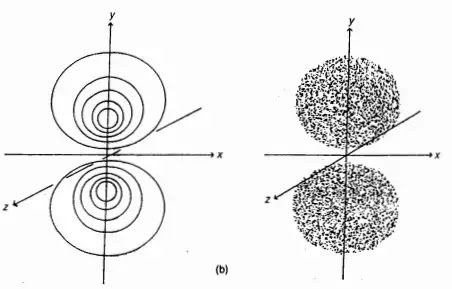
l. It is difficult to picture an angular wave function as a mathematical equation. It is much easier to visualize a boundary surface, which is a solid shape. which for example contains 90% of the electron density. To emphasize that Ψ is continuous. function, the boundary surfaces have been extended up to the nucleus in Figure 1.9. For p orbitals, the electron density is zero at the nucleus, and stone texts show a p orbital a' two spheres which do not touch.
2. These drawings show the symmetry for the ls, 2p, 3d orbitals. However, in the others, 2s, 3s, 4s . .. , 3p, 4p, Sp . .. , 4d, Sd . .. the sign (symmetry) changes inside the boundary surface Of the orbital. this is readily seen as nodes in the graphs Of the radial functions (Figure 1.8).
Radial And Angular Functions
For More Chemistry Notes and Helpful Content Subscribe Our YouTube Chanel - Chemistry Explain
Radial And Angular Functions
3. The probability of finding an electron at a direction θ, Φ is the wave function squared, A2 , or more precisely Ψ2θ, Ψ2ΦThe diagrams in Figure 1. 9 are of the angular part of the wave function A, not A2 Squaring does not change the shape of an s orbital, but it elongates the lobes of p orbitals (Figure 1.10). Some books use elongated p orbitals, but strictly these should not have signs, as squaring removes· any sign from the symmetry. Despite this, many authors draw shapes approximating to the probabilities, i.e. squared wave functions, and put the signs of the wave function on the lobes, and refer to both the shapes and the wave functions as orbitals.
4. A full representation of the probability of finding an electron requires the total wave function squared and includes both the radial and angular probabilities squared. It really needs a three-dimensional model to display this probability and show the shapes of the orbitals. It is difficult to do this adequately on a two-dimensional piece of paper, but a representation is shown in Figure 1.11. The orbitals are not drawn to scale. Note that the p orbitals are not simply two spheres, but are ellipsoids of revolution. Thus the 2px  orbital is spherically symmetrical about the x axis, but is not spherical in the other direction. Similarly, the Py orbital is spherically symmetrical about the y axis, and both the Pz and the 3dz2 are spherically symmetrical about the z axis.

Labels: , , ,

The Schrodinger Wave Equation definition

The Schrodinger Wave Equation - Atomic structure and the periodic table

Chemistry Explain provide notes about Atomic structure and the periodic table today we discuss “The Schrodinger Wave Equation” Inorganic Chemistry

Wave Equation
For a standing wave (such as a vibrating string) of wavelength λ, the whose amplitude at any point along x may be described by a function f (x). it can be shown that:
Wave Equation
If an electron is considered as a wave which moves in only one dimension then:
Wave Equation
An electron may move in three directions x. y and z so this becomes
Wave Equation
Using the · symbol ∇ instead of the three partial differentials, this is shortened to
Wave Equation
The de Broglie relationship states that
(where h is Planck's constant, m is the mass of an electron and v its velocity); hence:
or
However, the total energy of the system Eis made up of the kinetic energy K plus the potential energy V
Wave Equation

Substituting for v2 in equation (1.5) gives the well-known form of the Schrodinger equation
Wave Equation
Acceptable solutions to the wave equation, that are solutions which are physically possible, must have certain properties:
1. ♆ the must be continuous.
2. ♆ the must be fi.nite.
3. ♆ the must be single-valued.
4. The probability of finding the electron over all the space from plus infinity to minus infinity must be equal to one.
The probability of finding an electron at a point x, y, z is ♆2, so
Wave Equatio
Several wave functions called ♆1. ♆2 , ♆3 . will satisfy these conditions to the wave equation, and each of these has a corresponding energy E1, E2 , E3 . Each of these wave functions ♆1 ♆2 , etc. is called an orbital, by analogy with the orbits in the Bohr theory. In a hydrogen atom, the single electron normally occupies the lowest bf the energy levels E1• This is called the ground state. The corresponding wave function ♆1 describes the orbital, which is the volume in space where there is a high probability of finding the electron.
For a given type of atom, there are a number of solutions to the wave equation which are acceptable, and each orbital may be described uniquely by a set of three quantum numbers, n, I, and m. (These are t_he same quantum numbers - principal, subsidiary and magnetic - as were used in the Bohr theory).
The subsidiary quantum number I describe the shape of the orbital occupied by the electron. l may have values 0, 1, 2 or 3. When I= 0, the orbital is spherical and is called an s orbital; when I = l, the orbital is dumb-bell shaped and is called a p orbital; when I= 2, the orbital is double dumb-bell shaped and is called a d orbital; and when I = 3 a more complicated f orbital is formed (see Figure 1.6). the letters s, p, d and i come from the spectroscopic terms sharp, principal, diffuse and
Wave Equatio
.fundamental, which were used to describe the lines in the atomic spectra.
Wave Equatio
Wave Equatio
Wave Equatio
For More Chegg Questions
Examination of a list of all the allowed solutions to the wave equation shows that the orbitals fall into groups. In the first group of solutions the value of the wave function ♆ and
hence the probability of finding the electron ♆2 depends only on the distance r from the nucleus and is the same in all directions.
♆ = f(r)
This leads to a spherical orbital and occurs when the subsidiary quantum number I is zero. These are called s orbitals. When I = 0, the magnetic quantum number m = 0, so there is only one such orbital for each value of n.
In the second group of solutions to the wave equation, ♆ depends both on the distance from the nucleus, and on the direction in space (x, y or z). Orbitals of this kind occur when the subsidiary quantum number I = 1. These are called p orbitals and there are three possible values of the magnetic quantum number (m = -1, 0and+1). There are therefore three orbitals that are identical in energy, sh.ape, and size, which differ only in their direction in space. These three solutions to the wave equation may be written
Wave Equatio
Orbitals that are identical in energy are termed degenerate, and thus three degenerate p orbitals occur for each of the values of n = 2, 3, 4 ... The third group of solutions to the wave equation depends on the
Wave Equatio
For More Chemistry Notes and Helpful Content Subscribe Our YouTube Chanel - Chemistry Explain
distance from the nucleus r and also on two directions in space, for example
Schrodinger
This group of orbitals has I = 2, and these are called d orbitals. there are five solutions corresponding tom = -2, -1, 0, + 1 and +2, and these are all equal in energy. Thus five degenerated orbitals occur for each of the values of n = 3, 4, 5 .... A further set of solutions occurs when I = 3, and- these are called f orbitals. There are seven values of tn: -3, -2, -l, O", +l, +2 and +3, and seven degenerate f orbitals are formed when n = 4, 5, 6 ....

Labels: , , ,

Tuesday, July 21, 2020

The Heisenberg Uncertainty Principle

The Heisenberg Uncertainty Principle - Atomic structure and the periodic table

Chemistry Explain provide notes about Atomic structure and the periodic table today we discuss “The Heisenberg Uncertainty Principle” Inorganic Chemistry
Uncertainty Principle
Calculations on the Bohr model of an atom require precise information about the position of an electron an(f its velocity. It is difficult to measure both quantities accurately at the same time. An electron is too small to see and may only be observed if perturbed. For example, we could hit the electron with another particle such as a photon or an electron, or we could apply an electric or magnetic force to the electron. This will inevitably change the position of the electron, or its velocity and direction. Heisenberg stated that the more precisely we cart define the position of an electron. the less certain we are able to define its velocity. and vice versa. If l:!..x is the uncertainty in defining the position and !:!.. v the uncertainty in the velocity, the uncertainty principle may be expressed mathematically as:
For More Chegg Questions
Uncertainty Principle
where h = Planck's constant = 6.6262 x 10- 34 J s. This implies that it is impossible to know both the position and the velocity exactly. The concept of an electron following a definite orbit, where its position and velocity are known exactly, must therefore be replaced by the probability of finding an electron in a particular position, or in a particular volume of space. The Schrodinger wave equation provides a satisfactory description of an atom in these terms. Solutions to the wave equation are
For More Chemistry Notes and Helpful Content Subscribe Our YouTube Chanel - Chemistry Explain
called wave functions and given the symbol Ψ. The probability of finding an electron at a point in space whose coordinates are x, y and z is Ψ2 (x, y, z).

Labels: , , ,

The Dual Nature of Electrons Particles or Waves

The Dual Nature of Electrons Particles or Waves - Atomic structure and the periodic table

Chemistry Explain provide notes about Atomic structure and the periodic table today we discuss “The Dual Nature of Electrons Atomic Particles or Waves” Inorganic Chemistry
Dual Nature of Electrons
The planetary theory of atomic structure put forward by Rutherford and Bohr describes the atom as a central nucleus surrounded by electrons in certain orbits. The electron is thus considered as a particle. In the 1920s it was shown that moving particles such as electrons behaved in some ways as waves. This is an important concept in explaining the electronic structure of atoms .. For some time light has been considered as either particles or waves. Certain materials such as potassium emit electrons when irradiated with visible light, or in some cases with ultraviolet light.
Dual Nature of Electrons

For More Chegg Questions
This is called the photoelectric effect. It is explained by light traveling as particles called photons. If a photon collides with an electron, it can transfer its energy to the electron. If the energy of the photon is sufficiently large it can remove the electron from the surface of the metal. However, the phenomena of diffraction and interference of light can only be explained by assuming that light behaves like waves. In 1924, de Broglie postulated that the same dual character existed with electrons - sometimes they are considered as particles, and at other times it is more convenient to consider them as waves.
For More Chemistry Notes and Helpful Content Subscribe Our YouTube Chanel - Chemistry Explain
Experimental evidence for the wave nature of electrons was obtained when diffraction rings were observed photographically when a stream of elec;trons was passed through a thin metal foil. Electron diffraction has now become a useful tool in determining molecular structure, particularly of gases. Wave mechanics is a means of studying the build-up of electron shells in atoms, and the shape of orbitals occupied by the electrons.

Labels: , , ,

Friday, July 17, 2020

Refinements of The Bohr Theory

Refinements of The Bohr Theory - Atomic structure and the periodic table

Chemistry Explain provides notes about Atomic structure and the periodic table today we discuss “Refinements of The Bohr Theory” Inorganic Chemistry.
Refinements of The Bohr Theory
It has been assumed that the nucleus remains stationary except for rotating on its own axis. This would be true if the mass of the nucleus were infinite, but the ratio of the mass of an electron to the mass of the hydrogen nucleus is 111836. The nucleus actually oscillates slightly about the center of gravity, and to allow for this the mass of the electron m is replaced by the. reduced mass µ in equation (1.4):
Refinements of The Bohr Theory

where M is the mass of the nucleus. The inclusion of the mass of the nucleus explains why different isotopes of an element produce lines in the spectrum at slightly different wavenumbers. The orbits are sometimes denoted by the letters K, L, M, N ... counting outwards from the nucleus, and they are also numbered 1, 2, 3, 4 ... This number is called the principal quantum number, which is given the symbol
Refinements of The Bohr Theory

Figure 1.4 Bohr orbits of hydrogen and the various series of spectral lines.
n. It is, therefore, possible t<> define which circular orbit is under consideration by specifying the principal quantum number. When an electron moves from one orbit to another it should give a single sharp line in the spectrum, corresponding precisely to the energy difference between the initial and final orbits. If the hydrogen spectrum is observed ~ with a high-resolution spectrometer it is found that some of the lines reveal 'fine structure'. This means that a line is really composed of several lines close together. Sommerfeld explained this splitting of lines by assuming that some of the orbits were elliptical; and that they precessed in space around the nucleus. For the orbit does to the nucleus, the principal quantum number n = 1, and there is a circular orbit. For the next orbit, #1e principal quantum number n = 2, and both circular and elliptical orbits ~re possible. To define an elliptical orbit, a second quantum number k is needed. The shape of the ellipse is defined by the ratio Of the lengths of the major arid minor axes. Thus
k is called the azimuthal or subsidiary quantum number and may have values from 1, 2 ... Ii. Thus for fl = 2, all may have the values 2/2 (circular orbit) and 2/1 (elliptical orbit). For the principal quantum number n = 3, nlk may have values 3/3 (circular),
Refinements of The Bohr Theory

3/2 (ellipse), and 3/1 (narrower ellipse). The presence of these extra orbits, which have slightly different energies k = 1 from each other, accounts for the extra lines in the spectrum revealed under high resolution. The original quantum number k has now been replaced by a new quantum number /, where I = k - 1. Thus for
Refinements of The Bohr Theory

This explained why some of the spectral lines are split into two, three, four, or more lines. In addition, some spectral lines are split still further into two lines (a double). This is explained by assuming that an electron spins on its axis in either a clockwise or an anticlockwise direction. Energy is quantized. and the value of the spin angular momentum was first considered to be ms· h/2n, where ms is the spin quantum number with values of ±~- (Quantum mechanics has since shown the exact expression to be Vs(s + I)· h/2n, where s is either the spin quantum number or the resultant of several spins.)
Zeeman showed that if atoms were placed in a strong magnetic field additional lines appeared on the spectrum. This is because elliptical orbits can only take up certain orientations with respect to the external field. rather than precessing freely. Each of these orientations is associated with a fourth quantum number m which can have values of l. (/ - I) .. . . 0 ... (-/ + I).-/. Thus a single line in the normal spectrum will appear as (2/ + 1) lines if a magnetic field is applied. Thus in order to explain the spectrum· of the hydrogen atom, four quantum numbers are needed, as shown in Table 1.2. The spectra of other atoms may be explained in a similar manner.

Labels: , ,

The Bohr Theory and Atomic Spectra of Hydrogen

The Bohr Theory and Atomic Spectra of Hydrogen - Atomic structure and the periodic table

Chemistry Explain provide notes about Atomic structure and the periodic table today we discuss “The Bohr Theory and Atomic Spectra of Hydrogen” Inorganic Chemistry
The Bohr Theory and Atomic Spectra of Hydrogen
When atoms are heated or subjected to an electric discharge, they absorb energy, which is subsequently emitted ~s radiation. For example, if sodium chloride is heated in the flame of a bunsen burner' sodium atoms are produced which gives rise to the characteristic yellow flame coloration. (There are two lines in the emission spectrum of sodium corresponding to wavelengths of589.0nm and 589.6nm.) Spectroscopy is a study of either the radiation absorbed or the radiation emitted. Atomic spectroscopy is an important technique for studying the energy and the arrangement of electrons in atoms.
If a discharge is passed through hydrogen gas (H2) at low pressure, some hydrogen atoms (H) are formed, which emit light in the visible region. This light can he studied with u spectrometer and is found to comprise a series of lines of different wavelengths. Four lines can be seen by eye, but many more are observed photographically in the ultraviolet region. The lines become increasingly close together as the wavelength (A.) decreases until the continuum is reached (Figure 1.3). Wavelengths, in meters, are related to the frequency, v, in Hertz (cycles/second) by the equation:
The Bohr Theory and Atomic Spectra of Hydrogen
Figure 1.3 Spectrum of hydrogen in the visible region (Bahner series.)
The Bohr Theory and Atomic Spectra of Hydrogen
where R is the. Rydberg constant and n has the values 3, 4. 5 ...• thus giving a series of lines. The lines observed in the visible region are called the Balmer series. but several other series of lines may be observed in different regions of the spectrum (Table 1.1). Similar equations were found to hold for the lines in the other series in the hydrogen spectrum
The Bohr Theory and Atomic Spectra of Hydrogen
In the early years of this century, attempts were made to obtain a physical picture of the atom from this and other evidence. Thomson had shown in 1896 that the application of a high electrical potential across a gas gave electrons, suggesting that these were present in atoms. Rutherford suggested from alpha-particle scattering experiments that an atom consisted of a heavy positively charged nucleus with a sufficient number of electrons around it to make the atom electrically neutral. In 1913, Niels Bohr combined these ideas and suggested that the atomic nucleus was surrounded by electrons moving in orbits like planets around the sun. He was awarded the Nobel Prize for Physics in 1922 for his work on the structure of the atom. Several problems arise with this concept:
I. The electrons might be expected to slow down gradually.
2. Why should electrons move in an orbit around t~e nucleus? ·
3. Since the nucleus and electrons have opposite charges, they should attract each other. Thus one would expect the electrons to spiral inwards until eventually, they collide with the nucleus.
To explain these problems Bohr postulated:
l. An electron did not radiate energy if it stayed in one orbit, and therefore did not slow down. ·
2. When an electron moved from one orbit to another it either radiated or absorbed energy. If it moved towards the nucleus energy was radiated and if it moved away from the nucleus energy was absorbed.
3. For an electron to remain in its orbit the electrostatic attraction between the electron and the nucleus which tends to pull the electron towards the nucleus must be equal to the centrifugal force which tends to throw the electron out of its orbit. For an electron of mass m, moving with a velocity v in an orbit of radius r
The Bohr Theory and Atomic Spectra of Hydrogen
According to Planck's quantum theory, energy is not continuous but is discrete. This means that energy occurs in 'packets' called quanta, of magnitude h/2rt, where h is Planck's constant. The energy of an electron in an orbit, that is its angular momentum mvr, must be equal to a whole number n of quanta.

The experimental value of R is 1.097373 x 10⁷ m - 1 , in good agreement with the theoretical value of 1.096776 x 10⁷ m- 1 • The Bohr theory provides an explanation of the atomic spectra of hydrogen. The different series of spectral lines can be obtained by varying the values of ni and fir in equation (1.4). Thus with nr = 1 and ni = 2, 3, 4 ... we obtain the Lyman series of lines in the UV region. With nr = 2 and ni = 3, 4, 5 ... we get the Balmer series of lines in the visible spectrum. Similarly, nr = 3 and n; = 4, 5, 6 . .. gives the Paschen series, nr = 4 and ni = 5, 6, 7 ... gives the Brackett series, and nr = 6 and n;- = 7, 8, 9 ... gives the Pfund series. The various transitions which are possible between orbits are shown in Figure 1.4.

Labels: , ,