Thursday, December 24, 2020

#630 The 4.00-kg block in the figure isattached

The 4.00-kg block in the figure is attached - Physics

ChemistryExplain daily providing Q&A content “#630 The4.00-kg block in the figure is attached" in Physics, Ap physics 1 practice test, Best colleges for physics, Best physics books, Best physics schools

Chemistryexplain  “#630 The4.00-kg block in the figure is attached" in Physics, Ap physics 1 practice test, Best colleges for physics, Best physics

Get the Free Online Chemistry Q&A Questions And Answers with explain. To crack any examinations and Interview tests these Chemistry Questions And Answers are very useful. Here we have uploaded the Free Online Chemistry Questions. Here we are also given the all chemistry topic.

ChemistryExplain team has covered all Topics related to inorganic, organic, physical chemistry, and others So, Prepare these Chemistry Questions and Answers with Explanation Pdf.

For More Chegg Questions

Join Our Telegram Channel for Covers All Update by ChemistryExplain:- Click Now

Free Chegg Question

The 4.00-kg block in the figure is attached to a vertical rod by means of two strings. When the system rotates about the axis of the rod, the strings are extended as shown in the diagram, and the tension in the upper string is80.0 N.
A)What is the tension in the lower cord?
B)How many revolutions per minute does the system make?
C)Find the number of revolutions per minute at which the lower cord just goes slack.
Chemistryexplain  “#630 The4.00-kg block in the figure is attached" in Physics, Ap physics 1 practice test, Best colleges for physics, Best physics

Free Chegg AnswerFor More Chemistry Notes and Helpful Content Subscribe Our YouTube Chanel - Chemistry Explain  

Best Free Chegg Answer


We have the following forces acting on the weight

    F1    = upper string VECTOR (up and to the left)
    F2    = lower string VECTOR (down and to the left)
    W    = weight VECTOR (straight down)

The net force is the addition of these forces

    F(net) = F1 + F2 + W

By observation, the weight moves in a horizontal plane, therefore the net force is purely horizontal.

    F(net) = ( F3, 0) N

where F3 is unknown at the moment, but we expect it to be -ve, because the motion is centripetal (& therefore to the left at the instant of time of the drawing)

We need to get some results for F1, F2 and W.
Now W is the easiest,

    W = (0, -40) N   (vector is straightdown with magnitude 4N*10m/s^2 = 40N)

F1 & F2 will lie along the direction of the strings (upper and lower), and will therefore make similar triangles with that formed by the pole and the strings.

Hence from diagram we have for F1,

    x : y : r = 0.75m : 1m : 1.25m =   48N: 64N : 80N

from similar triangles OR

       F1 = (-48, 64) N   [-ve sign because it points left and up from the weight ]

& for F2 we have,

    x : y : r = 0.75m : 1m : 1.25m =  0.6*T :0.8*T : T

i.e.
       F2 = (-0.6T , -0.8T ) [-ve signs point down and to the left from the weight ]

Remembering we have,

    F(net) = F1 + F2 + W

or after substituting,

    (F3, 0) = (-48, 64) + (-0.6T , -0.8T ) + (0,-40)

A)

This gives two equations, firstly the y-component,

    0 = 64 - 0.8T + -40    => T =30N

B)

and then the x-component

    F3 = -48 -0.6T                     
    => F3 = -48 -18 = -66 N

Now F3 is a centripetal force, so

    F3 = mw^2R
    => w = sqrt(66/(4*0.75)) = 4.7 rad/s

which still needs to be converted to RPM.

C)

The tensions in the strings are going to change, but the strings will remain at the same angles. The strings are of equal length and hence cant change their positions
when under tension.

i.e. if T1 is the tension in the upper string, and T2 is thetension in the lower string we have,

       F1 = (-0.6T1 , 0.8T1 )
       F2 = (-0.6T2 , -0.8T2 )

    from similar triangles as above.

    we still have

        F(net) = F1 + F2 +W

    which gives,

    (F3, 0) = (-0.6T1, 0.8T1) + (-0.6T2 , -0.8T2 ) +(0, -40)

    when the cord goes slack (T2 =0) so,

    y-component,

        0 = 0.8T1 - 40, => T1 =50N

    x-component,

    F3 = -0.6*50N = -30N

    F3 = mw^2R
    => w = sqrt(30/(4*0.75)) = 3.2 rad/s

we'd expect that the angular speed should decrease in order for the bottom string to go slack.

Hope that helps

Labels: , ,

Tuesday, December 22, 2020

#629 A child pulls a 7.00 kg sled along a flat surface

A child pulls a 7.00 kg sled along a flat surface - Physics

ChemistryExplain daily providing Q&A content “#629 A child pulls a 7.00 kg sled along a flat surface" in Physics, Ap physics 1 practice test, Best colleges for physics, Best physics books, Best physics schools

ChemistryExplain “#629 A child pulls a 7.00 kg sled along a flat surface  in Physics, Ap physics 1 practice test, Best colleges for physics, Best physics books
Get the Free Online Chemistry Q&A Questions And Answers with explain. To crack any examinations and Interview tests these Chemistry Questions And Answers are very useful. Here we have uploaded the Free Online Chemistry Questions. Here we are also given the all chemistry topic.

ChemistryExplain team has covered all Topics related to inorganic, organic, physical chemistry, and others So, Prepare these Chemistry Questions and Answers with Explanation Pdf.

For More Chegg Questions

Join Our Telegram Channel for Covers All Update by ChemistryExplain:- Click Now

Free Chegg Question

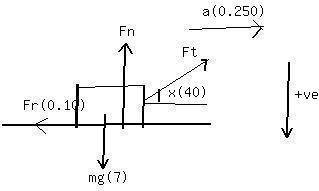
A child pulls a 7.00 kg sled along a flat surface.  The coefficient friction between the sled and the snow is 0.100.  The string that the child pulls with is angles at 40 degrees.  If the sled's acceleration is 0.250 m/s2, with how much force is the child pulling?

Free Chegg AnswerFor More Chemistry Notes and Helpful Content Subscribe Our YouTube Chanel - Chemistry Explain  

Best Free Chegg Answer


ChemistryExplain “#629 A child pulls a 7.00 kg sled along a flat surface  in Physics, Ap physics 1 practice test, Best colleges for physics, Best physics books

From the force diagram applying F=ma for the xand y components.

X comp: FtCosx – Fr = ma

      Or    Ft Cosx- µFn = ma -----------------(1)        

Ycomp:   Fn + FtSinx – mg =0

       Or       Fn= mg – FtSinx

Substituting in eq.(1) we get FtCosx - µ(mg –FtSinx) = ma

                 Or    Ft = [ m(a + µg)] /(Cosx + µSinx)}

                               =[7(0.250 + 0.1x9.8)]/(Cos40 +0.10 Sin40)

                          Ft = 10.4N

Free Chegg Answer 2

Frictional force = uN, where u is 0.1 and N is the weight of the body, which is 70N. Therefore, frictional force is 7N. Since the angle is 40 degrees, it's horizontal component , F cos 40, is equal to (ma friction) , which is 7.7 * 0.250 = 1.925 N. Hence, F = 1.925/cos 40. Which is 2.5 N

Free Chegg Answer 3

Frictional force = uN, where u is 0.1 and N is the weight of the body, which is 70N. Therefore, frictional force is 7N. suppose boy is pulling with force F Since the angle is 40 degrees, it's horizontal component , F cos 40, Now Fcos40 - 7N = m*a Fcos 40 = 7N + 7*.25 = 8.75N F = 8.75/ cos 40 = 8.75/.766 = 11.422 N

Labels: , ,

#628 A girl is whirling a ball on a string around

A girl is whirling a ball on a string around - Physics

ChemistryExplain daily providing Q&A content “#628 A girl is whirling a ball on a string around" in Physics, Ap physics 1 practice test, Best colleges for physics, Best physics books, Best physics schools

ChemistryExplain “#628 A girl is whirling a ball on a string around in Physics, Ap physics 1 practice test, Best colleges for physics, Best physics books
Get the Free Online Chemistry Q&A Questions And Answers with explain. To crack any examinations and Interview tests these Chemistry Questions And Answers are very useful. Here we have uploaded the Free Online Chemistry Questions. Here we are also given the all chemistry topic.

ChemistryExplain team has covered all Topics related to inorganic, organic, physical chemistry, and others So, Prepare these Chemistry Questions and Answers with Explanation Pdf.

For More Chegg Questions

Join Our Telegram Channel for Covers All Update by ChemistryExplain:- Click Now

Free Chegg Question

A girl is whirling a ball on a string around her head in a horizontal plane. She wants to let go at precisely the right time so that the ball will hit a target on the other side of the yard. When should she let go of the string?

Free Chegg AnswerFor More Chemistry Notes and Helpful Content Subscribe Our YouTube Chanel - Chemistry Explain  

Free Chegg Answer

 
The girl should let of go the string at the instant the ball is directly opposite the target because now the centripetal force becomes zero as the radial acceleration is zero and the ball has only tangential acceleration and hence the ball will fly off tangentially and hit the target.

Labels: , ,

#627 A 205 kg log is pulled up a ramp by means

A 205 kg log is pulled up a ramp by means - Physics

ChemistryExplain daily providing Q&A content “#627 A 205 kg log is pulled up a ramp by means" in Physics, Ap physics 1 practice test, Best colleges for physics, Best physics books, Best physics schools

ChemistryExplain “#627 A 205 kg log is pulled up a ramp by means in Physics, Ap physics 1 practice test, Best colleges for physics, Best physics books
Get the Free Online Chemistry Q&A Questions And Answers with explain. To crack any examinations and Interview tests these Chemistry Questions And Answers are very useful. Here we have uploaded the Free Online Chemistry Questions. Here we are also given the all chemistry topic.

ChemistryExplain team has covered all Topics related to inorganic, organic, physical chemistry, and others So, Prepare these Chemistry Questions and Answers with Explanation Pdf.

For More Chegg Questions

Join Our Telegram Channel for Covers All Update by ChemistryExplain:- Click Now

Free Chegg Question

A 205 kg log is pulled up a ramp by means of a rope that is parallel to the surface of the ramp. The ramp is inclined at30% with respect to the horizontal. The coefficient of kinetic friction between the log and the ramp is 0.900 and the log has an acceleration of 0.800 m/s2. Find the tension in the rope.

Free Chegg AnswerFor More Chemistry Notes and Helpful Content Subscribe Our YouTube Chanel - Chemistry Explain  

Free Chegg Answer

ChemistryExplain “#627 A 205 kg log is pulled up a ramp by means in Physics, Ap physics 1 practice test, Best colleges for physics, Best physics books
As the log is pulled along the ramp, using F = ma for the x and y components we have
X comp:    cramster-equation-2005924354436326313088
Or             cramster-equation-2005924356586326313101------------(1)
Y comp:      cramster-equation-2005924358446326313112
Or               cramster-equation-2005924359316326313117
Substituting in eq.(1) we get
                      cramster-equation-2005924413663263131296
Or                  cramster-equation-2005924431963263131399
Substituting tne values, we get
                      cramster-equation-2005924474632631316243
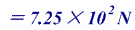
                             cramster-equation-2005924495632631317454

Labels: , ,

#626 The Concorde traveled 8000km between two places

The Concorde traveled 8000km between two places - Physics

ChemistryExplain daily providing Q&A content “#626 The Concorde traveled 8000km between two places" in Physics, Ap physics 1 practice test, Best colleges for physics, Best physics books, Best physics schools

ChemistryExplain “#626 The Concorde traveled 8000km between two places in Physics, Ap physics 1 practice test, Best colleges for physics, Best physics books
Get the Free Online Chemistry Q&A Questions And Answers with explain. To crack any examinations and Interview tests these Chemistry Questions And Answers are very useful. Here we have uploaded the Free Online Chemistry Questions. Here we are also given the all chemistry topic.

 ChemistryExplain team has covered all Topics related to inorganic, organic, physical chemistry, and others So, Prepare these Chemistry Questions and Answers with Explanation Pdf.

For More Chegg Questions

Join Our Telegram Channel for Covers All Update by ChemistryExplain:- Click Now

Free Chegg Question

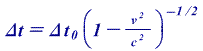
The Concorde traveled 8000km between two places in NorthAmerica and Europe at an average speed of 375 m/s. What is the total difference in time between two similar atomic clocks, one on the airplane and the other one at rest on the earth during a one-way trip? Consider only time dilation and ignore other effects like the rotation on the earth.

Free Chegg AnswerFor More Chemistry Notes and Helpful Content Subscribe Our YouTube Chanel - Chemistry Explain  

Free Chegg Answer

The time is taken by the Concorde t = d/v
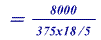
                                                   cramster-equation-2005927211346326338389
                                                     cramster-equation-2005927212476326338396
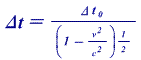
The time recorded by the clock on the Earth = cramster-equation-2005927214206326338406
                                                    cramster-equation-2005927220146326338441
                                                    cramster-equation-2005927228163263384881
By using the Binomial theorem we have
                                                 cramster-equation-2005927250406326338624        cramster-equation-2005927230286326338502
                                                          =    cramster-equation-2005927247166326338603
                                     or             cramster-equation-2005927249366326338617
                                                             cramster-equation-2005927253256326338640
                                                              cramster-equation-2005927313963263386899hrs
                                       or cramster-equation-2005927324463263386964

Labels: , ,

#625 What is the equation for the force of an object traveling

What is the equation for the force of an object traveling - Physics

ChemistryExplain daily providing Q&A content “#625 What is the equation for the force of an object traveling" in Physics, Ap physics 1 practice test, Best colleges for physics, Best physics books, Best physics schools

ChemistryExplain “#625 What is the equation for the force of an object traveling in Physics, Ap physics 1 practice test, Best colleges for physics
Get the Free Online Chemistry Q&A Questions And Answers with explain. To crack any examinations and Interview tests these Chemistry Questions And Answers are very useful. Here we have uploaded the Free Online Chemistry Questions. Here we are also given the all chemistry topic.

 ChemistryExplain team has covered all Topics related to inorganic, organic, physical chemistry, and others So, Prepare these Chemistry Questions and Answers with Explanation Pdf.

For More Chegg Questions

Join Our Telegram Channel for Covers All Update by ChemistryExplain:- Click Now

Free Chegg Question

What is the equation for the force of an object traveling at5m/s/s?

Free Chegg AnswerFor More Chemistry Notes and Helpful Content Subscribe Our YouTube Chanel - Chemistry Explain  

Free Chegg Answer

The equation for the Force of an object according to Newton'ssecond Law is
                                        F=ma
                         therefore F=5m Newtons where m is the mass of the body.

Labels: , ,

Sunday, November 22, 2020

#509 Starting from rest, a 68.0 kg woman jumps

Starting from rest, a 68.0 kg woman jumps - Physics

ChemistryExplain daily providing Q&A content “#509 Starting from rest, a 68.0 kg woman jumps" in Physics, Ap physics 1 practice test, Best colleges for physics, Best physics books, Best physics schools

ChemistryExplain “#509 Starting from rest, a 68.0 kg woman jumps in Physics, Ap physics 1 practice test, Best colleges for physics, Best physics books
Get the Free Online Chemistry Q&A Questions And Answers with explain. To crack any examinations and Interview tests these Chemistry Questions And Answers are very useful. Here we have uploaded the Free Online Chemistry Questions. Here we are also given the all chemistry topic.

 ChemistryExplain team has covered all Topics related to inorganic, organic, physical chemistry, and others So, Prepare these Chemistry Questions and Answers with Explanation Pdf.

For More Chegg Questions

Join Our Telegram Channel for Covers All Update by ChemistryExplain:- Click Now

Free Chegg Question

Starting from rest, a 68.0 kg woman jumps down to the floor from a height of 0.790 m, and immediately jumps back up into the air. While she is in contact with the ground during the time interval

0 < t < 0.800 s,

the force she exerts on the floor can be modeled using the function

F = 9,200t − 11,500t2

where F is in newtons and t is in seconds.

(a) What impulse (in N · s) did the woman receive from the floor? (Enter the magnitude. Round your answer to at least three significant figures.)

in N · s

(b) With what speed (in m/s) did she reach the floor? (Round your answer to at least three significant figures.)

in m/s

(c) With what speed (in m/s) did she leave it? (Round your answer to at least three significant figures.)

in m/s

(d) To what height (in m) did she jump upon leaving the floor?

in m

Free Chegg AnswerFor More Chemistry Notes and Helpful Content Subscribe Our YouTube Chanel - Chemistry Explain  

Free Chegg Answer

ChemistryExplain “#509 Starting from rest, a 68.0 kg woman jumps in Physics, Ap physics 1 practice test, Best colleges for physics, Best physics books

 ChemistryExplain “#509 Starting from rest, a 68.0 kg woman jumps in Physics, Ap physics 1 practice test, Best colleges for physics, Best physics books

Labels: , ,

Saturday, November 21, 2020

#503 A girl of mass mg is standing on a plank of mass

A girl of mass mg is standing on a plank of mass - Physics

ChemistryExplain daily providing Q&A content “#503 A girl of mass mg is standing on a plank of mass" in Physics, Ap physics 1 practice test, Best colleges for physics, Best physics books, Best physics schools

ChemistryExplain “#503 A girl of mass mg is standing on a plank of mass in Physics, Ap physics 1 practice test, Best colleges for physics, Best physi

Get the Free Online Chemistry Q&A Questions And Answers with explain. To crack any examinations and Interview tests these Chemistry Questions And Answers are very useful. Here we have uploaded the Free Online Chemistry Questions. Here we are also given the all chemistry topic.

 ChemistryExplain team has covered all Topics related to inorganic, organic, physical chemistry, and others So, Prepare these Chemistry Questions and Answers with Explanation Pdf.

For More Chegg Questions

Join Our Telegram Channel for Covers All Update by ChemistryExplain:- Click Now

Free Chegg Question

A girl of mass mg is standing on a plank of mass mp. Both are originally at rest on a frozen lake that constitutes a frictionless, flat surface. The girl begins to walk along the plank at a constant velocity vgp to the right relative to the plank. (The subscript gp denotes the girl relative to plank. Use any variable or symbol stated above as necessary.)
1.) What is the velocity vpi of the plank relative to the surface of the ice?
2.) What is the girl's velocity vgi relative to the ice surface?

Free Chegg AnswerFor More Chemistry Notes and Helpful Content Subscribe Our YouTube Chanel - Chemistry Explain  

Free Chegg Answer

ChemistryExplain “#503 A girl of mass mg is standing on a plank of mass in Physics, Ap physics 1 practice test, Best colleges for physics, Best physi


Labels: , ,

Friday, November 20, 2020

#500 A uniform piece of sheet metal is shaped as

A uniform piece of sheet metal is shaped - Physics

ChemistryExplain daily providing Q&A content “#500 A uniform piece of sheet metal is shaped as" in Physics, Ap physics 1 practice test, Best colleges for physics, Best physics books, Best physics schools

ChemistryExplain “#500 A uniform piece of sheet metal is shaped as in Physics, Ap physics 1 practice test, Best colleges for physics, Best physics bo
Get the Free Online Chemistry Q&A Questions And Answers with explain. To crack any examinations and Interview tests these Chemistry Questions And Answers are very useful. Here we have uploaded the Free Online Chemistry Questions. Here we are also given the all chemistry topic.

 ChemistryExplain team has covered all Topics related to inorganic, organic, physical chemistry, and others So, Prepare these Chemistry Questions and Answers with Explanation Pdf.

For More Chegg Questions

Join Our Telegram Channel for Covers All Update by ChemistryExplain:- Click Now

Free Chegg Question

A uniform piece of sheet metal is shaped as shown in the figure below. Compute the x and y coordinates of the center of mass of the piece.

ChemistryExplain “#500 A uniform piece of sheet metal is shaped as in Physics, Ap physics 1 practice test, Best colleges for physics, Best physics bo

Free Chegg AnswerFor More Chemistry Notes and Helpful Content Subscribe Our YouTube Chanel - Chemistry Explain  

Free Chegg Answer

ChemistryExplain “#500 A uniform piece of sheet metal is shaped as in Physics, Ap physics 1 practice test, Best colleges for physics, Best physics bo

Labels: , ,

#499 Consider the two pucks shown in the figure

Consider the two pucks shown in the figure - Physics

ChemistryExplain daily providing Q&A content “#499 Consider the two pucks shown in the figure" in Physics, Ap physics 1 practice test, Best colleges for physics, Best physics books, Best physics schools

ChemistryExplain “#499 Consider the two pucks shown in the figure in Physics, Ap physics 1 practice test, Best colleges for physics, Best physics books
Get the Free Online Chemistry Q&A Questions And Answers with explain. To crack any examinations and Interview tests these Chemistry Questions And Answers are very useful. Here we have uploaded the Free Online Chemistry Questions. Here we are also given the all chemistry topic.

 ChemistryExplain team has covered all Topics related to inorganic, organic, physical chemistry, and others So, Prepare these Chemistry Questions and Answers with Explanation Pdf.

For More Chegg Questions

Join Our Telegram Channel for Covers All Update by ChemistryExplain:- Click Now

Free Chegg Question

Consider the two pucks shown in the figure. As they move towards each other, the momentum of each puck is equal in magnitude and opposite in direction. Given that vi, green = 8.0 m/s, and mblue is 40.0% greater than mgreen, what are the final speeds of each puck (in m/s), if the kinetic energy of the system is converted to internal energy?

ChemistryExplain “#499 Consider the two pucks shown in the figure in Physics, Ap physics 1 practice test, Best colleges for physics, Best physics books

Free Chegg AnswerFor More Chemistry Notes and Helpful Content Subscribe Our YouTube Chanel - Chemistry Explain  

Free Chegg Answer

ChemistryExplain “#499 Consider the two pucks shown in the figure in Physics, Ap physics 1 practice test, Best colleges for physics, Best physics books

Labels: , ,

Thursday, November 19, 2020

#496 An object has a kinetic energy of 284

An object has a kinetic energy of 284 - Physics

ChemistryExplain daily providing Q&A content “#496 An object has a kinetic energy of 284" in Physics, Ap physics 1 practice test, Best colleges for physics, Best physics books, Best physics schools

ChemistryExplain #496 An object has a kinetic energy of 284 in Physics, Ap physics 1 practice test, Best colleges for physics, Best physics
Get the Free Online Chemistry Q&A Questions And Answers with explain. To crack any examinations and Interview tests these Chemistry Questions And Answers are very useful. Here we have uploaded the Free Online Chemistry Questions. Here we are also given the all chemistry topic.

 ChemistryExplain team has covered all Topics related to inorganic, organic, physical chemistry, and others So, Prepare these Chemistry Questions and Answers with Explanation Pdf.

For More Chegg Questions

Join Our Telegram Channel for Covers All Update by ChemistryExplain:- Click Now

Free Chegg Question

An object has a kinetic energy of 284 J and a momentum of magnitude 23.5 kg · m/s.

(a) Find the speed of the object.
m/s

(b) Find the mass of the object.
kg

Free Chegg AnswerFor More Chemistry Notes and Helpful Content Subscribe Our YouTube Chanel - Chemistry Explain  

Free Chegg Answer

General guidance

Concepts and reason

The concept used to solve this problem is related energy and momentum of an object.

First, eliminate the mass by dividing the expression of kinetic energy by momentum. It gives the velocity of the object. Finally, rearrange the expression of momentum for mass and calculate it.

Fundamentals

The expression of kinetic energy of a moving object is given by,

K=21​mv2

Here, mis mass of the object,v is the velocity.

The expression of kinetic energy of a moving object is given by,

p=mv

Here, mis mass of the object,v is the velocity.

Step 1 of 2

(a)

Calculate the velocity of the object.

The expression of kinetic energy of a moving object is given by,

K=21​mv2

Here, mis mass of the object,v is the velocity.

The expression of kinetic energy of a moving object is given by,

p=mv

Here, mis mass of the object,v is the velocity.

Divide the expression K=21​mv2 byp=mv,

pK​=mv21​mv2​=21​v​

Rearrange it forv,

v=p2K​

Substitute 284J for K and 23.5kg⋅m⋅s−1 forp,

v=23.5kg⋅m⋅s−12(284J)​=24.2m⋅s−1​

Part a

The velocity of the object is24.2m⋅s−1.


Explanation | Common mistakes | Hint for next step

Divide the kinetic energy by the momentum of the particle. By dividing it, we eliminate the mass. Then, substitute the known values in the expression of velocity.

Step 2 of 2

(b)

Calculate the mass of the object.

Rearrange the expression of momentum as follows,

m=vp​

Substitute 23.5kg⋅m⋅s−1 for p and 24.2m⋅s−1 forv,

m=24.2m⋅s−123.5kg⋅m⋅s−1​=0.971kg​

Part b

The mass of the object is0.971kg.


Explanation | Common mistakes

Rearrange the expression of momentum foe mass and substitute the values of momentum and velocity in it.

Answer

Part a

The velocity of the object is24.2m⋅s−1.

Part b

The mass of the object is0.971kg.

Labels: , ,

#493 The magnitude of the net force exerted

The magnitude of the net force exerted - Physics

ChemistryExplain daily providing Q&A content “#493 The magnitude of the net force exerted" in Physics, Ap physics 1 practice test, Best colleges for physics, Best physics books, Best physics schools

ChemistryExplain “#493 The magnitude of the net force exerted in Physics, Ap physics 1 practice test, Best colleges for physics, Best physics books

Get the Free Online Chemistry Q&A Questions And Answers with explain. To crack any examinations and Interview tests these Chemistry Questions And Answers are very useful. Here we have uploaded the Free Online Chemistry Questions. Here we are also given the all chemistry topic.

 ChemistryExplain team has covered all Topics related to inorganic, organic, physical chemistry, and others So, Prepare these Chemistry Questions and Answers with Explanation Pdf.

For More Chegg Questions

Free Chegg Question

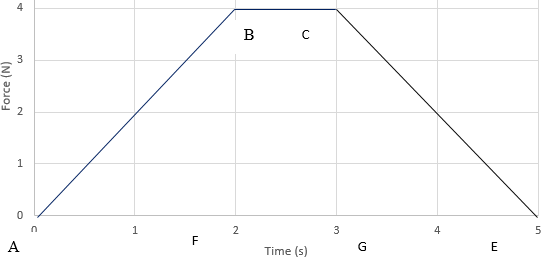
The magnitude of the net force exerted in the x direction on a 3.90-kg particle varies in time as shown in the figure below.

(a) Find the impulse of the force over the 5.00-s time interval. I = ? (N · s)

(b) Find the final velocity the particle attains if it is originally at rest. Vf = ? (m/s)

(c) Find its final velocity if its original velocity is -3.10 i m/s. Vf = ? (m/s)

(d) Find the average force exerted on the particle for the time interval between 0 and 5.00 s. Favg = ? (N)

ChemistryExplain “#493 The magnitude of the net force exerted" in Physics, Ap physics 1 practice test, Best colleges for physics, Best physics books

Free Chegg AnswerFor More Chemistry Notes and Helpful Content Subscribe Our YouTube Chanel - Chemistry Explain  

Free Chegg Answer

General guidance

Concepts and reason

The concepts used to solve this question is the impulse

Initially, draw the graph and then the impulse is determined by calculating the area under the graph. Later use the impulse to find the initial and final velocities of the particle. At last use the relation between impulse, force and time to determine average force acting on the particle.

Fundamentals

Impulse:

Impulse is a vector quantity and has both magnitudes as well as direction. It is defined as the product of the force acting on the particle and time interval at which force is acting on the particle.

The magnitude of the impulse is,

I=FΔt

Here, F is the force acting on the particle and Δt is the time interval.

The impulse is also defined as the change in momentum of the particle.

I=mΔv

Here, m is the mass of the particle and Δv is the change in velocity.

Step 1 of 4

(a)

The graph between the force and the time is drawn below.

ChemistryExplain “#493 The magnitude of the net force exerted" in Physics, Ap physics 1 practice test, Best colleges for physics, Best physics books

The area of the graph gives the impulse.

Therefore,

I=Area(ABF)+Area(BCFG)+Area(CEG)=(21​)(4N)(2s)+(4N)(1s)+(21​)(4N)(2s)=2(4N⋅s)+4N⋅s=12N⋅s​

Part a

The impulse of the force over the time interval 5s is 12N⋅s


Explanation | Common mistakes | Hint for next step

The area under the graph gives the impulse. The units of the impulse is N⋅s . The area of the graph is formed by two triangles and one rectangle. The total area of the graph is the sum of the area of two triangles and one rectangle.

Step 2 of 4

(b)

The final velocity of the particle is,

I=m(vf​−vi​)

The above equation is modified as,

vf​=mI​+vi​ …… (1)

Here, vi​ is the initial velocity of the particle.

Substitute 12N⋅s for I , 3.90kg for m and 0m/s for vi​ in the equation (1).

vf​=mI​+vi​=3.90kg12N⋅s​+0m/s=3.076m/s​

Part b

The final velocity of the particle is 3.076m/s


Explanation | Common mistakes | Hint for next step

The particle starts from rest and therefore the initial velocity of the particle is zero. Hence, the final velocity of the particle depends on the impulse and mass of the particle.

Step 3 of 4

(c)

The final velocity of the particle is,

vf​=mI​+vi​ …… (2)

Here, vi​ is the initial velocity of the particle.

Substitute 12N⋅s for I , 3.90kg for m and −3.10m/s for vi​ in the equation (2).

vf​=mI​+vi​=3.90kg12N⋅s​−3.10m/s=−0.024m/s​

Part c

The final velocity of the particle is −0.024m/s


Explanation | Common mistakes | Hint for next step

The initial velocity of the particle is known and therefore by using the impulse equation, the final velocity of the particle has been determined.

Step 4 of 4

(d)

The average force exerted on the particle is,

F=ΔtI​ …… (3)

Substitute 12N⋅s for I and 5s for Δt in the equation (3).

F=ΔtI​=5s12N⋅s​=2.4N​

Part d

The average force exerted on the particle is 2.4N


Explanation | Common mistakes

The force acting on the particle is,

F∝I

And,

F∝Δt1​

Hence, from the above relations, the average force acting on the particle is directly proportional to the impulse. Hence, with an increase in the impulse, the average force exerted on the particle will increase.

Answer

Part a

The impulse of the force over the time interval 5s is 12N⋅s

Part b

The final velocity of the particle is 3.076m/s

Part c

The final velocity of the particle is −0.024m/s

Part d

The average force exerted on the particle is 2.4N

Labels: , ,